Key Takeaways
On a $33,000 KeHE opening order, the deductions that come out first shrink the remittance to $16,671, about 51% of the invoice.
Our example brand’s cash waits about 120 days between the co-packer deposit on day 5 and the KeHE payment on day 125, because KeHE’s current supplier policy holds a new supplier’s first payment until the opening inventory sells.
Moving the co-packer’s $10,800 production balance to net 30 terms cuts the wait on that money to 65 days, and selling through in 45 days moves KeHE’s payment up to day 95.
Bridging the wait takes $28,619 in the example, which is the cash still out at the first remittance plus the next production batch.
KeHE’s opt-in Administrative Allowance Program folds several first-year fees into one 2% flat rate for suppliers under $500,000 in their first year, pending approval by the supplier manager.
It’s the email you’ve been waiting for. A 110-store natural chain wants both flavors of your canned cold brew, and the buyer has one request, which is that the cases ship through KeHE. You celebrate, and you should, because a first natural chain authorization is the kind of news Founders shout from the rooftops.
Then questions about UNFI and KeHE payment terms arrive, usually once the celebratory glass of cold brew is empty and the spreadsheet is open. You start asking when the money leaves, when it comes back, how much of the invoice survives the trip, and who covers the gap in between.
I’m Maggie Ojeda, a Financial Account Manager at Cultivar, and I’d love to sit beside you while we work through them. My more than 10 years in finance include Accenture and P&G, plus four years in winemaking cost control at Grupo Peñaflor, one of Argentina’s top wine producers, so I have a soft spot for any product that costs real money to make before anyone buys it.
Our brand sells canned cold brew in two flavors, which count as two SKUs, the individual products a retailer tracks. The brand does $1,800,000 in annual gross sales, or $150,000 a month. Each 24-can case sells to KeHE for $30.00 and costs $13.50 to make. KeHE orders 1,100 cases for its two distribution centers, and the co-packer’s minimum is 1,600 cases. The brand also funds a launch promotion of $0.25 a can on 350 cases, or 8,400 cans.
What Happens to My Cash When a KeHE or UNFI Opening Order Arrives?
When a KeHE or UNFI opening order comes in, cash leaves first for the co-packer and then for freight, and the distributor pays later. The opening order is a distributor’s first purchase order to stock its warehouses with your item. I count the day the order comes in as day 0, and every outflow gets a day number after that.
| Day | What happens | Cash out | Cash out so far |
|---|---|---|---|
| 0 | KeHE’s 1,100-case opening order comes in | $0 | $0 |
| 5 | Co-packer deposit on the 1,600-case minimum | $10,800 | $10,800 |
| 30 | Production balance due on completion | $10,800 | $21,600 |
| 34 | Freight on 1,100 cases at $1.90 | $2,090 | $23,690 |
| 40 | Cases arrive at KeHE’s two distribution centers | $0 | $23,690 |
Cash out reaches $23,690 by day 34, about 16% of a month’s gross sales. The 500 extra cases above KeHE’s order, worth $6,750 at cost, wait in your inventory for reorders.
How Do UNFI and KeHE Payment Terms Work on a First Order?
On a first order, KeHE’s 2015 policy holds a new supplier’s payment until the opening inventory sells to retail customers. UNFI sets its timing in each supplier agreement, so the dated example here follows KeHE. KeHE’s Supplier Policies and Procedures, in the edition effective November 1, 2025, still hold a new supplier’s initial orders until they sell through.
On the 2015 benchmark of 2% 10, net 30 terms, KeHE takes 2% off the net invoice for paying within 10 days. Otherwise KeHE pays the net amount within 30 days. In our example, the net invoice is the invoice minus the off-invoice new item allowance covered below.
When Does KeHE Pay a New Supplier’s Initial Purchase Order?
KeHE pays an initial purchase order, its first order to a new supplier at each warehouse, once the opening inventory has sold to retail customers. The same 2015 policy gives KeHE a six-month guaranteed sale. If initial-order items are still unsold after six months, you credit KeHE in full at its landed cost. Our example assumes the cold brew sells through by day 115, and KeHE pays on day 125.
Where Do I Find My UNFI Payment Window?
Your UNFI supplier agreement sets the payment window and any prompt-payment discount. I’d build your forecast on the dates in that written agreement and ask your UNFI contact to confirm them.
What Comes Out of My First UNFI or KeHE Payment?
Under UNFI and KeHE payment terms, your first payment arrives as a remittance net of deductions. The remittance is the payment plus a statement listing each amount subtracted.
Free fill is the free product a retailer requires when your item enters each store. Sprouts, a natural chain that publishes its rules, makes a handy reference. Sprouts’ vendor policy page, last modified August 19, 2024, values grocery free fill at wholesale and has KeHE or UNFI deduct it on Sprouts’ behalf. Our example chain follows the same pattern, with one case per SKU per store valued at KeHE’s wholesale price of $37.50, which is higher than your $30.00 case price because distributors calculate deductions on their own retailer-facing price. That works out to 110 stores and two SKUs, or 220 cases.
KeHE’s new item introduction allowance had a 2015 minimum of 15% off invoice per new item and warehouse. KeHE’s 2015 policy also required a 1.5% marketing allowance on all purchases and a one-time $40 per SKU imaging fee, and our example leaves both out, so ask your supplier manager if your agreement includes them. MCB stands for manufacturer chargeback, a promotional discount KeHE gives retailers and bills back to you every two weeks. In our example, the $0.25-a-can launch promotion reaches you as an MCB.
SPS Commerce’s May 2026 guide to KeHE MCBs puts the current processing fee at 8% of the MCB amount, with a $65 minimum per distribution center. KeHE’s 2015 policy set that fee at 5%. Setup fees at 2015 rates are $50 per SKU centrally and $50 per SKU per warehouse. Our two SKUs and two distribution centers, which count as two warehouses, come to $100 centrally plus $200 at the warehouses.
| Remittance line | Math | Amount |
|---|---|---|
| Invoice | 1,100 cases × $30.00 | $33,000 |
| New item introduction allowance | 15% × $33,000 | −$4,950 |
| Setup fees | 2 × $50 + 4 × $50 | −$300 |
| Free fill | 220 cases × $37.50 | −$8,250 |
| Launch MCB | 8,400 cans × $0.25 | −$2,100 |
| MCB processing fee | 8% × $2,100 (2026 rate) | −$168 |
| Early-payment discount | 2% × $28,050 net invoice | −$561 |
| First remittance | About 51% of the invoice | $16,671 |
I’ve assumed KeHE still takes the 2% discount on a held first payment, which is the cautious choice for your cash and gives $561.
Our post on the Gross-to-Net Realities of UNFI & KeHE explains why distributors calculate deductions on their own retailer-facing price.
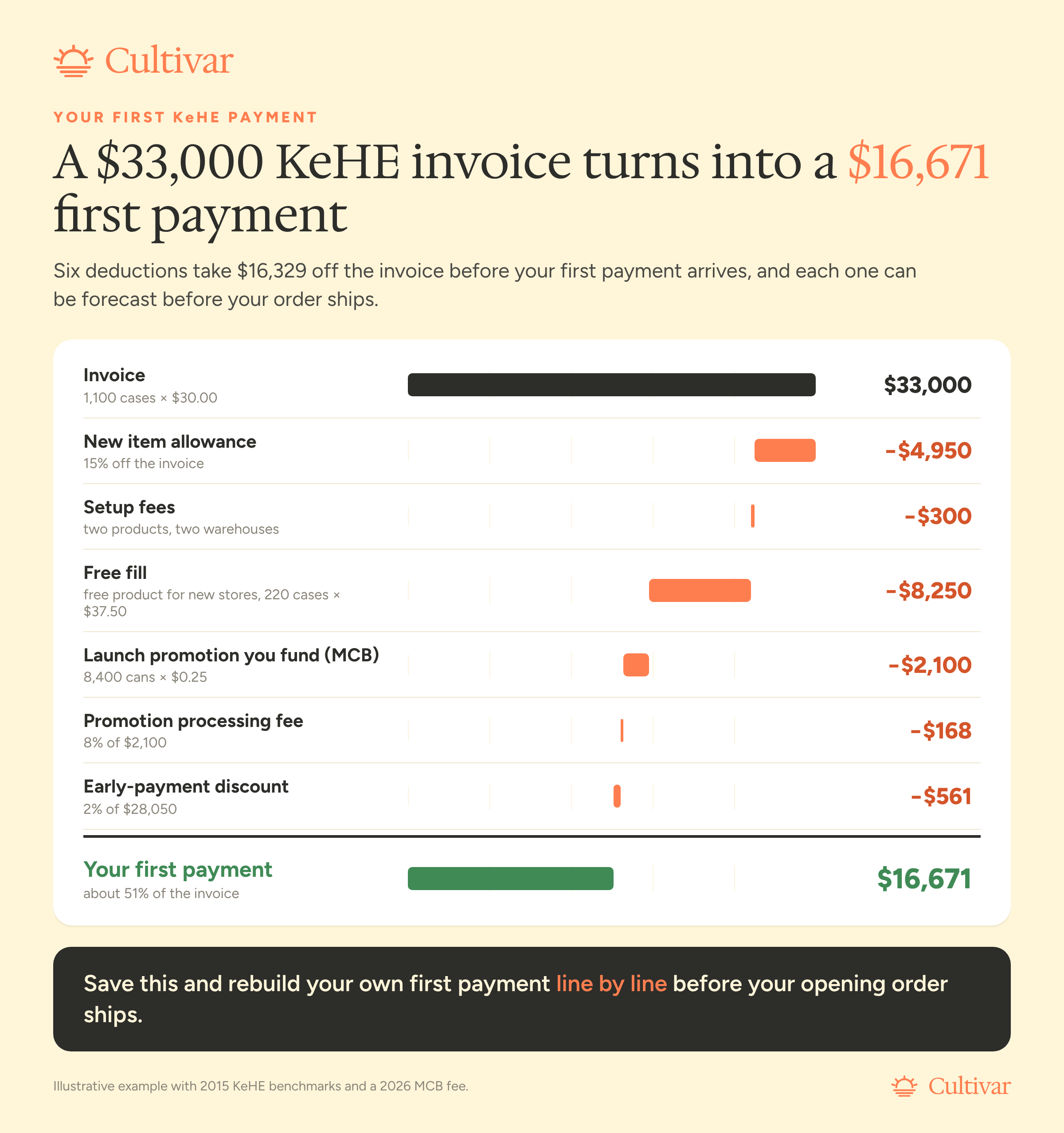
Save this to rebuild your own first remittance before your opening order ships.
What Is KeHE’s Administrative Allowance Program?
KeHE’s opt-in Administrative Allowance Program, or AAP, folds several first-year fees into one 2% flat rate, among them new item introduction allowances, extra performance fees, manufacturer chargebacks, and new item setup fees. KeHE offers it to new and small suppliers under $500,000 and within their first year at KeHE, pending review and approval by their supplier manager. KeHE’s supplier programs page doesn’t say if the $500,000 limit counts revenue or purchases, so ask your supplier manager which one applies. KeHE’s supplier programs page (August 2026) and BevNET’s December 10, 2024 report both describe it.
How Long Does My Cash Wait Between the Purchase Order and the Bank?
Cash on a first KeHE order waits about 120 days in our example, moving through the co-packer, transit, the distributor’s shelves, and the payment cycle. That’s the stretch between the day 5 co-packer deposit and the day 125 remittance. After the remittance arrives on day 125, $23,690 minus $16,671 leaves $7,019 out. The initial purchase order hold is your longest wait, so sell-through speed, meaning how fast shoppers buy your opening inventory, sets your payment date.
Net 30 terms, which make payment due 30 days after the invoice, move the co-packer’s $10,800 balance to day 60 instead of day 30, cutting that money’s wait to 65 days. Selling through in 45 days, 30 days faster than our example’s 75-day sell-through, moves KeHE’s payment up to day 95. Both sell-through counts start on day 40, when the cases reach KeHE. Weekly Alec’s Ice Cream cash monitoring was part of Cultivar’s work during that brand’s equity raise, alongside vendor negotiations to stretch cash.
Every first order under UNFI and KeHE payment terms deserves its own dated forecast, and the first distributor payment date is the line I’d circle. At Cultivar, we treat every deduction as trade spend and cash flow at the same moment.
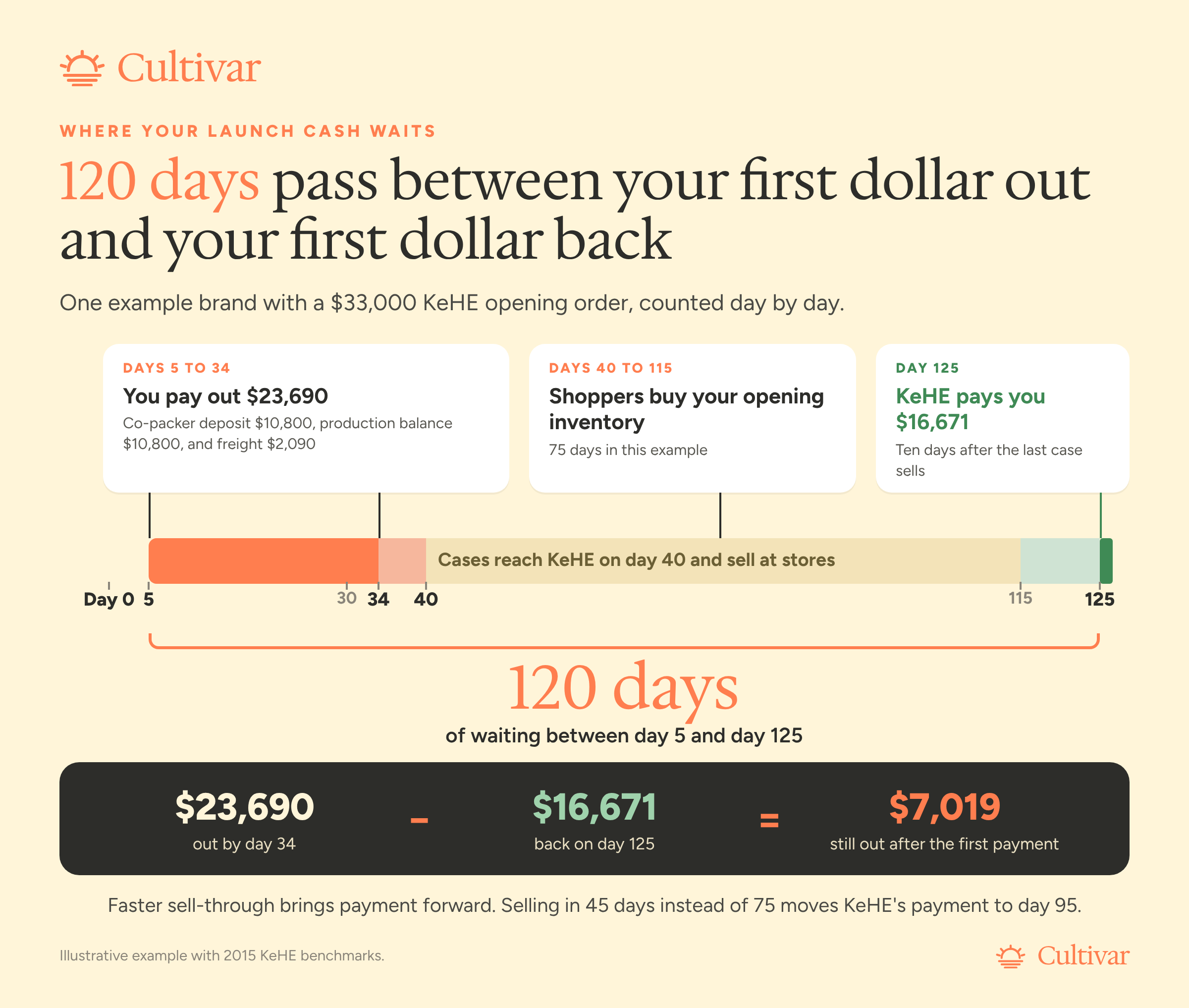
Share this with your business partner to see where launch cash sits before the first check.
How Can I Fund the Wait for My First Distributor Check?
Founders fund the wait for a first distributor check with cash on hand or outside money, such as an SBA microloan or Kickfurther’s inventory financing. Size the need as the cash still out at the first remittance plus your next production batch. In our example, that’s $7,019 + $21,600 = $28,619. That figure assumes your next production batch matches the first and gets paid for before any reorder cash arrives.
Each one works a little differently:
The SBA Microloan program makes loans up to $50,000 through nonprofit intermediary lenders. Uses include working capital and inventory. Each SBA-approved intermediary makes its own credit decisions and sets your loan terms, so ask it about collateral and a personal guarantee.
Kickfurther funds up to 100% of inventory cost by paying your manufacturer directly. It charges a funding fee plus a monthly consignment fee, and payments start once you receive the inventory and begin selling it.
Kickfurther’s CPG page lists a minimum of $200,000 in trailing 12-month revenue. Its December 2025 update says brands with $200,000 to $400,000 in revenue qualify when they hold active purchase orders with national retailers, so confirm the current minimum before you apply. I’d set Kickfurther’s repayment dates beside KeHE’s payment dates in your forecast. Selling to KeHE starts months before KeHE’s first payment arrives, and you’ll want those two calendars side by side.
Cultivar’s CPG cash flow forecasting predicts when cash comes in and goes out across sales, production, trade spend, and funding timelines.
What Should I Ask KeHE or UNFI Before My Opening Order Ships?
Before your opening order ships, ask KeHE, UNFI, the retailer, and your co-packer for current terms and the first payment’s release date.
Group your questions by who answers them:
Ask your KeHE supplier manager when KeHE releases a held first payment and if the 2% discount applies to it.
Ask your UNFI contact if your brand is enrolled in UNFI’s Simplified Supplier Approach, which Nosh reported in June 2024 as one 2.5% fee on purchases.
Ask the retailer’s category manager for your free fill quantity and the wholesale price it’s valued at.
Ask your co-packer if the production balance can move to net 30 terms.
When the first remittance arrives, compare it with your forecast line by line. Send me your first UNFI or KeHE purchase order, and let’s put a date on every dollar that leaves your account and every dollar that comes back. Book a cash timing call with me.
Frequently Asked Questions
How Long Does KeHE Take to Pay a New Supplier’s First Invoice?
KeHE’s 2015 policy pays a new supplier’s first invoice once the opening inventory has sold to retail customers, so the wait follows sell-through. In our example, a canned cold brew brand with a $33,000 opening order sells through by day 115 and KeHE pays on day 125, about 120 days after the co-packer deposit. Your KeHE supplier manager can confirm the release timing in the current Supplier Policies and Procedures, effective July 1, 2026.
Does UNFI Hold Payment on a New Brand’s First Purchase Order?
Your UNFI supplier agreement sets the payment window and any prompt-payment discount, so the written agreement is where a hold on a first purchase order would appear. Ask your UNFI contact to confirm in writing how the agreement treats a new brand’s first purchase order, and build your forecast on those dates. Our example follows KeHE because KeHE’s 2015 policy publishes its first-order hold.
What Happens When KeHE Deductions Are Bigger Than the Invoice?
Under KeHE’s 2015 policy, any amount KeHE owes you is subject to set-off, which means KeHE can subtract what you owe it. If your deductions exceed your unpaid invoices and that balance stays open for 60 days, KeHE invoices you for the difference. You can dispute a deduction within 180 days, and KeHE credits you if it finds a deduction error. In our example, $16,329 of deductions against a $33,000 invoice still leaves a $16,671 payment. Your KeHE supplier manager can explain how the current policy treats larger deductions, so ask for the answer in writing.
Can an Emerging Brand Negotiate Payment Terms With UNFI or KeHE?
An emerging brand can raise payment timing with UNFI before signing the supplier agreement, because that agreement sets the payment window and any prompt-payment discount.
Related Resources
Cultivar’s trade spend management for CPG logs, categorizes, and verifies every chargeback and deduction.
Our guide to slotting fees and cash flow covers the shelf-space fees some retailers charge before store sales arrive.
The Spirit Tea cash flow forecast shows how Cultivar helped its Co-Founder see his runway and plan headcount and working capital investments while his bank balance lagged record sales.