Key Takeaways
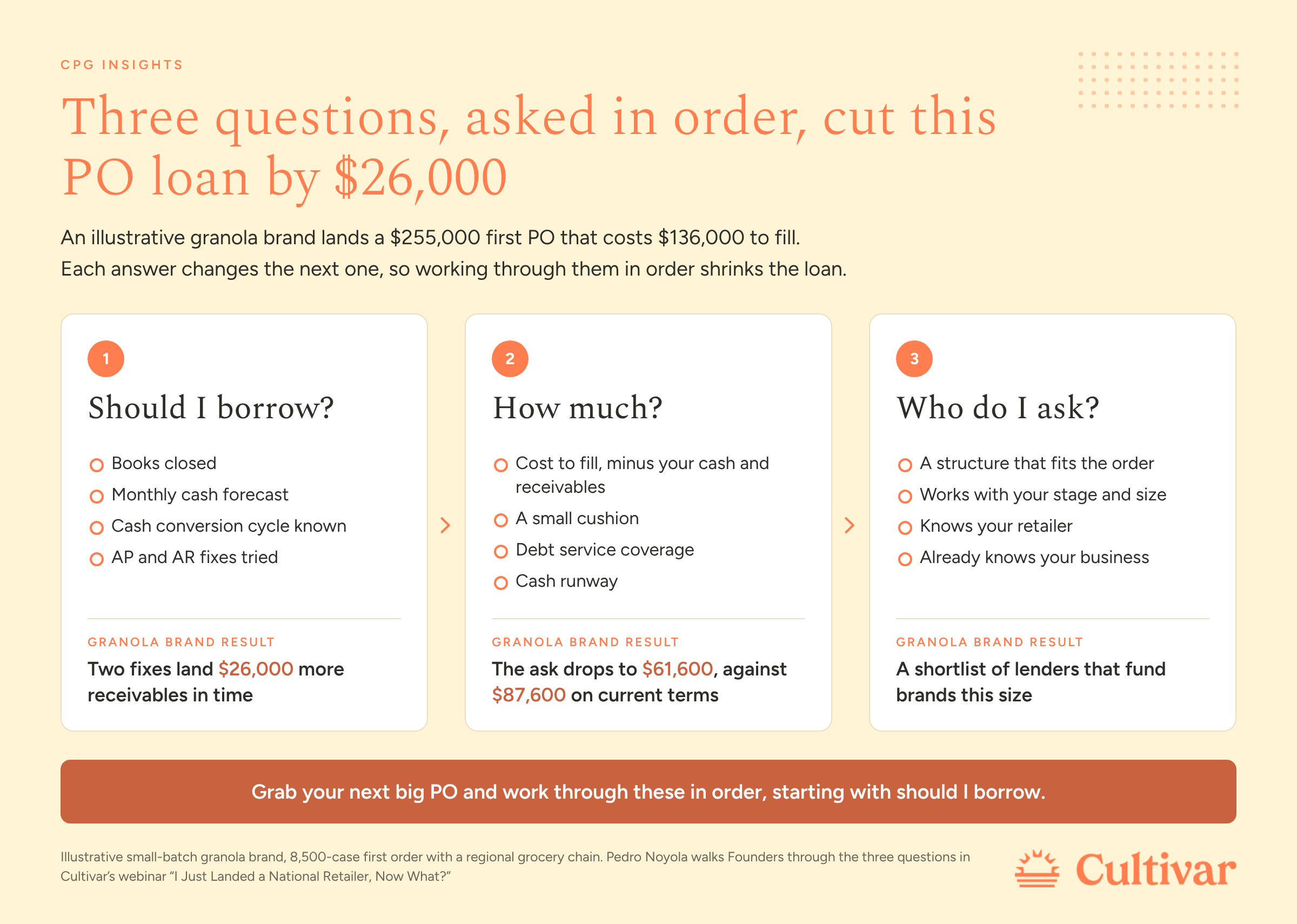
- Cultivar works every big PO through three questions in order, which are should I borrow, how much, and who to ask.
- The first question checks closed books, a monthly cash flow model, your cash conversion cycle, and quick payables and receivables fixes.
- Glenn of Prevail Jerky sized the Costco ask with materials, labor, net terms, and receivables timing, plus a small cushion.
- Owen of Wayflyer said brands can generally look at one to three times monthly revenue. Strong growth or a solid PO can move that range.
- Owen called burning cash workable for a high-growth brand. He reads under three months of runway as higher risk and six months or more as greener.
I’m Pablo Santos, and I built Cultivar’s loan support service. It’s helped CPG brands secure more than $2M in working capital. I lead accounting and trade spend for more than 75 US CPG, wine, and spirits brands. Plus, I own our standardized month-end close. Earlier in my career, I spent over 12 years at Cervecería Moonshine, rising to head of finance. There I grew revenue to $6M at a record 24% EBITDA margin.
Our CEO, Pedro Noyola, laid the three most pressing big PO questions out in Cultivar’s webinar “I Just Landed a National Retailer, Now What?” His guests were Ashley and Glenn, the Co-Founders of Prevail Jerky. They were joined by Owen, a credit manager on Wayflyer’s wholesale credit team. Prevail had just landed a Costco rotation, and Wayflyer funded the order. On working capital financing, Pedro said “this is something we do all day every day and we typically go through three questions.” The first is “should I borrow money?” and the second is “If that’s a yes, then how much?” The third question is who you should ask.
Grab a healthy snack, because we’re going to use a granola brand as an example as we talk through all three questions. It sells $1,680,000 a year, or $140,000 a month. Its first PO with a 180-store regional grocery chain is for 8,500 cases at $30.00 each. That’s $255,000, or about 1.8 times one month of sales. Filling it costs $136,000, which works out to $16.00 per case. Oats, nuts, honey, and packaging come to $89,250, and co-packer labor adds $46,750. The brand holds $80,000 in cash and burns a net $10,000 a month. In other words, $10,000 more leaves the bank than arrives each month.
Should I Borrow Money to Fund a Big Purchase Order?
To fund a large purchase order, start where Pedro starts. His first question is always “Should I borrow money?” Cultivar answers it with a four-item checklist. Working through that list often shrinks the loan, sometimes all the way to zero. Pedro walked through all four items on the webinar:
- “Are the books closed?” Closed books mean every month is matched to the bank statements and final.
- Your cash flow model can “forecast out your cash on a monthly basis.” Pedro said a weekly model “might not be absolutely required” at this stage.
- You know your cash conversion cycle, the days your cash is tied up between paying suppliers and getting paid. Pedro called it “an important factor for us in those early stages.”
- You’ve tried quick fixes on AP, or accounts payable, which is what you owe suppliers. AR, or accounts receivable, is what customers owe you. Pedro’s advice was that “you don’t necessarily need to take the loan right away if you can make some tweaks on your AP and go talk to your vendors, try to extend payment terms if you have a good relationship, you paid on time with them.” On the AR side, he said things improve “if you invoice really quickly and then you stay on top of the reminders.”
Pedro’s verdict was that Prevail “would have passed that with flying colors.” Prevail’s own starting point was unit COGS, meaning the cost to make one case. That cost adds ingredients and packaging to the co-packer’s labor. Glenn said the team focused on “making sure your COGS are really dialed in” a couple of years ago. Prevail was working toward Costco at the time. He explained that “when you’re getting an order of this size, you got to make sure that those numbers make sense.”
Pedro’s earlier post on how to afford a big retail opportunity tests the order itself. It uses a cash flow forecast and contribution margin modeling. Once your order passes that test, the AP and AR fixes come next.
The invoicing fix starts with two habits you can set up this week. The US Chamber of Commerce’s small business guide recommends automated reminders for overdue invoices. It also suggests asking vendors for extended payment terms. SCORE’s guide to improving collections adds a rule on sending invoices immediately. It also recommends following up by letter, email, or phone when a payment misses its due date. Y’all, both habits cost nothing to start.
Now watch what two fixes do for our granola brand. Its supplier terms today are net 30, meaning bills fall due 30 days after the invoice date. On those terms, $42,000 of open distributor invoices land in time to pay the order’s bills. Its long-time ingredient supplier agrees to move the $89,250 materials bill to net 45. The team also starts invoicing distributors on ship day, with reminders. The longer terms give distributor payments 15 more days to arrive. Ship-day invoicing starts each distributor’s clock sooner. Now $68,000 lands in time, up $26,000 on the $42,000 under net 30. That’s $26,000 less cash crunch, which leaves the granola as the only crunch in the building.
When a Founder brings me a PO, I ask for the last closed month first. The monthly cash forecast comes right after it. Owning Cultivar’s month-end close has turned me into someone who gets giddy over a freshly closed month.
How Much Should I Borrow to Fund a Purchase Order?
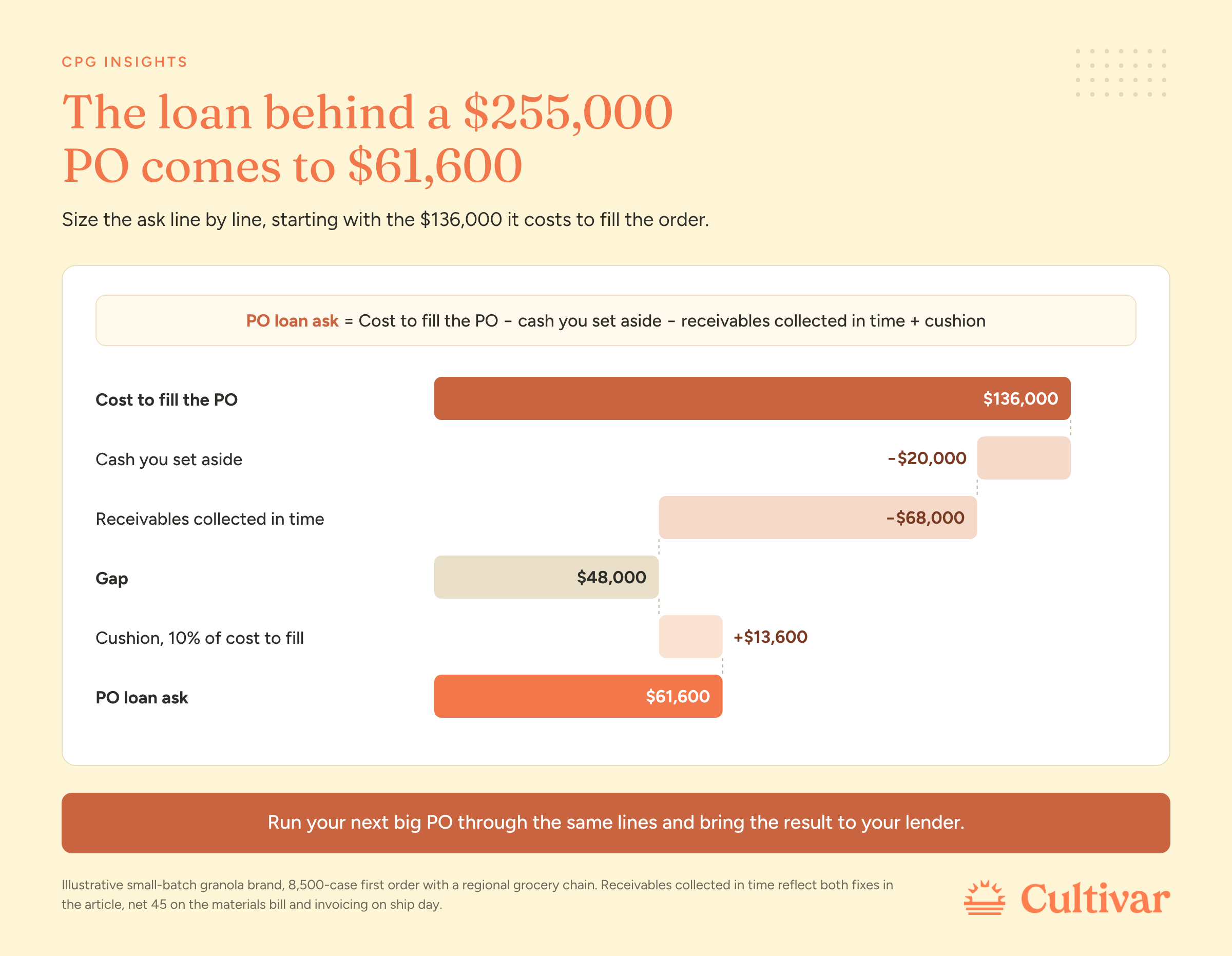
Borrow the order’s cash gap plus a small cushion. The gap is the cost to fill the PO minus your own cash and minus receivables that land in time. Then test the ask against debt service coverage and cash runway, the two checks Cultivar weighs most.
Pedro said “the two that are probably most important on our checklist is debt service coverage ratio and then cash runway.” Both sit on a long checklist with quick ratios, debt to asset, EBITDA, and other measures. Debt service coverage ratio is the cash a brand’s operations generate in a period divided by the loan payments due in that period. Cultivar built a debt schedule into the model behind our Alec’s Ice Cream AP financing work. The schedule helped the brand manage its debt facilities and hold safe cash levels.
Glenn’s method for Prevail’s Costco ask is the one I’d hand any Founder. He started honestly, saying “we’re still in the midst of it right now, so I’m hoping we did it correct.” Prevail factored in “all the elements of materials, labor” along with its net terms. Glenn matched the number to the timing of current receivables. He also matched it to the timing of the PO’s own payment. He said Prevail landed on a number that “was going to fulfill the order, maybe gave us a small cushion as a just in case, and played with the timing of when that PO was going to get paid.”
Our granola brand can put $20,000 of its own cash toward the order. It still holds $60,000, or six months of cash at its $10,000 monthly burn. Its cushion is 10% of the $136,000 cost to fill, or $13,600. Lay the two scenarios side by side and the ask sizes itself.
Your PO loan ask, side by side
| Line | On current terms | With both fixes |
|---|---|---|
| Cost to fill the PO | $136,000 | $136,000 |
| Cash you set aside | −$20,000 | −$20,000 |
| Receivables collected in time | −$42,000 | −$68,000 |
| Gap | $74,000 | $48,000 |
| Cushion (10% of cost to fill) | +$13,600 | +$13,600 |
| Ask | $87,600 | $61,600 |
The two fixes cut the ask by $26,000. That matches the extra receivables that now land in time, dollar for dollar. I get stoked when a PO’s cash gap comes down to one clean number like this.
Illustrative small-batch granola brand, 8,500-case first order with a regional grocery chain.
How Much Will a Lender Approve Against a Big PO?
Owen shared Wayflyer’s starting point on the webinar. He said “as a general rule of thumb within Wayflyer, brands can generally look at between one and three times monthly revenue.” That’s one lender’s view, so check the range with each lender you approach. Pedro pointed out that a multiple of past sales is “looking backwards.” Owen answered that a solid Costco PO can pull the number outside that range. Extreme, consistent growth can do the same. His worked case was a brand averaging $100,000 a month over six months. That brand was also up 100% year on year. “We wouldn’t just base their exposure amount on that $100,000 average over the previous six months,” he said. Exposure is the total a lender is prepared to have lent to you at one time.
For our granola brand, one to three times monthly revenue works out to $140,000 to $420,000. Its $61,600 ask is about 0.44 times one month of sales. That sits comfortably under the low end of the range. I love walking into a lender conversation with the ask already sized. The PO math sets the number, and the lender’s range confirms there’s room around it.
Can I Borrow If My Brand Is Burning Cash?
Yes, you can borrow while your brand burns cash. Owen called burn “definitely not a deal killer” on the webinar. He drew his line at runway, saying “short cash runway is a bit of a red flag, but burning cash isn’t an absolute no-go.” Cash runway is the number of months your cash lasts at your current monthly net burn. Owen also gave rough bands for reading it.
Owen’s runway bands, with the granola brand
| Band | Months of runway | Owen’s words | Granola brand |
|---|---|---|---|
| Higher risk | Under 3 | “anything below three months, you’d probably be verging into that higher risk territory” | |
| Amber | 3 to 6 | “Above three to five or six is in that amber” | |
| Greener | 6 and up | “Six plus you’re getting greener as you go” | 8.0 months today, 6.0 months with $20,000 in the order |
Our granola brand holds 8.0 months of runway today ($80,000 ÷ $10,000). Once its $20,000 goes into the order, it still holds 6.0 months ($60,000 ÷ $10,000). Owen added a fair caveat, saying “I don’t like giving absolute concrete numbers, but I think those are relatively okay gauges to work with.” I check runway twice with every Founder, once with their cash in the order and once without it.
Who Should I Ask to Fund a Big PO?
Ask a lender whose structure fits the order and who works with brands at your stage and size. The best fit also understands your retailer and already knows your business. For Prevail Jerky, that meant starting with Wayflyer, the lender it already worked with.
You gotta match the lender to the order. Pedro framed the third question as “who should I go ask.” Cultivar’s checklist for it has four parts:
- Pick a structure that fits this order, and our team can help you compare PO financing structures. Options include revenue-based financing, a line of credit, an inventory loan, and PO financing.
- Match the lender to your stage and size. As Pedro said, “It depends on the stage and the size of the company.”
- Favor a lender that knows your retailer. Glenn said of Wayflyer, “they’re aware of that type of an account like Costco, the reputation that they have.”
- Start with an existing relationship with a trusted partner when you have one. For Glenn, “it just made the utmost sense to at least start with them.”
PO financing pays your supplier against the signed order and collects when your customer pays. Our granola brand takes its $61,600 ask and its monthly forecast to a lender shortlist. Each lender on it funds brands this size and knows regional grocery chains. When I line up lenders with a Founder, I set the PO’s size beside each lender’s structure. The brand’s stage goes right next to it.
Why Do the Three Questions Work Best in Order?
The three questions work best in order because each answer sets up the next one. Fixes in the first question shrink the number in the second. The size of that number then points to the lenders that fit the third.
Cultivar’s view is that starting with the first question gives a Founder a smaller, sharper ask. Our granola brand trimmed its ask to $61,600 with one supplier conversation and a new invoicing habit. Prevail’s own result was still coming in at the time of the webinar, and Glenn’s update was cheerful. He said “so far so good. It looks like we’re on pace.”
Two habits hold the whole routine together for me:
- I share the sized ask with the lender alongside the forecast, so underwriting sees the math the Founder used.
- I revisit all three questions on every new PO, because each order changes the cash gap.
Start with the first question and bring a little ganas, the Spanish word for drive. The next two answers come faster once the first is done.
If a big PO just landed and you want the three questions answered with real numbers, I’d love to work through them with you. Talk to me and the Cultivar team.
Frequently Asked Questions
Can a Lender Approve More or Less Than I Ask For?
Yes, a lender can approve more or less than your ask, because underwriting sets its own number. Pedro said on the webinar that “underwriting comes back and agrees or disagrees with the number and can move it up or down.” Bring your line-by-line sizing so any change starts with your math.
Do I Need a Weekly Cash Flow Forecast to Get a Working Capital Loan?
You can answer the first question with a monthly cash flow forecast, and a weekly model can follow. Pedro said a weekly model shows what’s coming in through AR against what goes out for AP and payroll. That view gives you “that confidence that you can pay it back,” he said.
Why Do My COGS Need to Be Dialed In for a Big PO?
Your COGS need to be dialed in because any cost error multiplies across every case in a big order. Glenn said “everyone needs to know where their COGS are at, but the bigger the order, the more important it becomes.” In the granola example, a $1.00 error per case would move the cost to fill by $8,500.
How Do I Ask a Supplier for Longer Payment Terms?
Ask the supplier you’ve paid on time the longest for one specific change, such as net 45 on this PO’s materials bill. Share the PO and its ship date so they can see when the retailer’s money is due. The US Chamber of Commerce guide to payment terms lists extended vendor terms among its cash flow strategies.
Related Resources
- Our finance team’s scenario modeling for a big PO forecasts cash across sales, production, trade spend, and funding timelines, and models growth plans and pricing changes.
- Maggie’s post on margin left after inventory financing sets the turnover and margin tests that show when financed inventory still supports good growth.
- Our case study on the cost of every Schweiger bottle shows the SKU-level costing model Cultivar built for Schweiger Vineyards, with 100% of SKUs costed.