

Maggie Ojeda | Financial Account Manager, Cultivar
Executive MBA, IAE Business School · FP&A for Napa Valley wineries and US CPG brands
Last updated: November 23, 2026 · 9 min read
Key Takeaways
- Each bigger retailer brings a larger opening order plus its own launch spend, supplier terms, and wait for payment, and each win in the example pulls the bank balance lower.
- Prevail Jerky’s co-manufacturer switched off net 30 to weekly payment for the Costco order. The same switch adds $48,000 to the example’s club dip.
- One formula sizes any dip in buffer days, and the JPMorganChase Institute found the typical small business held 17.6 of those days in 2025.
Every big retail win for CPG brands pulls your bank balance lower than the last one because a bigger retailer ties up more cash during its wait. You can breathe a sigh of relief; what you’re going through is a normal part of growing a CPG brand. To prevent it in the future, plan working capital for retail expansion by sizing each dip while the offer is still open. You can measure it in dollars or cash buffer days. Our webinar guests, Prevail Jerky, lived this reality thanks to serious CPG retail wins at Whole Foods, Target, and Costco, in what Ashley called “a really wild year.”
I’m Maggie Ojeda, Financial Account Manager at Cultivar. I joined in 2024 as a Senior FP&A Consultant and went on to lead our US financial planning and analysis (FP&A) team as FP&A Manager. I specialize in FP&A for Napa Valley boutique wineries and US CPG brands. I earned my economics degree at Universidad Nacional de Cuyo and my Executive MBA at IAE Business School. My finance career spans more than 10 years, including roles at Accenture, P&G, and Grupo Peñaflor.
Pedro Noyola, our CEO, talked this exact pattern through when he hosted our webinar “I Just Landed a National Retailer, Now What?” His guests were Ashley, CEO and co-founder of Prevail Jerky, and Glenn, co-founder and president. Owen, a credit manager on Wayflyer’s wholesale credit team, joined us. Throughout this article, the “cash dip” means the drop in your bank balance during one retailer’s wait. It stretches between the first dollar that retailer costs you and the first payment it sends.
Our Kombucha Example
To watch the dip grow, follow our illustrative refrigerated kombucha brand with a team of four. It books $2,160,000 in annual gross sales, or $180,000 a month. Each 12-bottle case sells for $33.60 and costs $14.40 to make. The existing business is cash neutral, with $180,000 of outflows a month, or $6,000 a day. Its bank balance starts at $276,000, enough for 46 days of those outflows. Every figure is an assumption, and each day counts off the retailer’s PO date. The brand lands three wins in a row:
- Win 1 is a 60-store regional natural chain that orders 900 cases ($30,240). It also takes 180 free fill cases, the free product a retailer gets to stock new shelves. It asks for 30 tastings at $240 each and sends its first payment on day 40.
- Win 2 is one 320-store region of a national mass retailer that orders 3,840 cases ($129,024). It asks for 80 tastings at $240 and merchandisers at $3,200 a month. It also charges a $16,000 slotting fee, a one-time payment for shelf space, and pays on day 75.
- Win 3 is a 40-club rotation that orders 10,000 club cases at $31.20 ($312,000). Each case costs $15.36 once $0.96 of club packaging is added. The club starts with a $14,000 roadshow of in-club demos and pays on day 70.
The co-packer bills wins 1 and 2 on net 30, meaning payment is due 30 days after its invoice. Both bills fall due inside the wait for the first payment. For the club order, the co-packer takes a $9,600 packaging deposit at PO. It then moves to weekly payment of $24,000 for each of six batches. Those payments go out on days 14, 21, 28, 35, 42, and 49.
Why Does My Bank Balance Drop When Sales Go Up With a New Retailer?
Your bank balance drops when sales go up because you pay for the new retailer weeks ahead of its first payment. That timing gap is exactly what working capital covers. The co-packer, the launch costs, salaries, and rent all get paid while you wait. Pedro put it plainly on the webinar, saying, “The more you grow, the more cash you need.”
Ashley’s story of Prevail’s year is that pattern in real life. “We got a call that we got into Whole Foods, and it was like the highest of highs,” she said. Target followed with West Coast distribution across 400 doors. Then came a successful Costco roadshow and a rotation in Costco Texas. Ashley summed it up with “it’s been wild and we got to figure out how to pay for all those things.”
Pedro described the inside view as a cash balance going “lower and lower and lower” while sales climb. He followed that with the line “your cash doesn’t really match that story that everybody’s seeing on the outside.”
My earlier post on why revenue growth drains cash covers every place cash waits in a growing brand. Here we’ll stay on retailer wins. I read the sales line and the bank balance line side by side for every brand I forecast. When the gap between them widens, that’s my first sign a new account needs its own plan.
Why Does Each Bigger Retailer Need More Working Capital?
Each bigger retailer needs more working capital, meaning the cash a brand ties up while it waits to be paid. That cash sits in product, launch costs, payroll, and supplier bills. Four forces set the size of each retailer’s dip, which are the opening order, launch spend, supplier terms, and the wait for payment. Speaking as one lender, Owen of Wayflyer said “it compounds. The bigger the order gets, the more prevalent this issue is.”
- The opening order is the first force to grow. Owen’s sequence starts with “you’ve got to pay the manufacturer probably a deposit up front.” Payment around shipment comes next, and then “It could then be another 30, 60, 90 days depending on the retailer.” The size of that outlay is the order’s cost of goods. Glenn’s first step for Costco was to “buckle down and dial in our COGS and figure out what this was going to cost.”
- Launch spend depends on each retailer’s program. Glenn said making Target and Whole Foods successful involved tastings, promotions, and considering merchandisers. Eventually “there’s almost only so much cash in the bucket.” In our example, the club’s $14,000 roadshow costs less than the mass retailer’s $43,200 of tastings, merchandisers, and slotting.
- Supplier terms can tighten as orders grow. Glenn said Prevail’s production facility normally worked on net 30. For Costco, “they asked us to pay weekly as the product was coming out.” In our example, net 30 would put the club’s six batches due on days 44, 51, 58, 65, 72, and 79. The last two, worth $48,000, would fall after the club’s day 70 payment. Weekly payment pulls that $48,000 inside the dip, adding 8 days of outflows ($48,000 ÷ $6,000).
- The wait for payment shifts with each retailer. The club pays sooner than the mass retailer, on day 70 against day 75. It still brings the deepest dip, because order size and supplier terms outweigh the shorter wait. Good kombucha takes its time to ferment, and so does a retailer’s first payment.
I lay out these four forces for every offer a Founder brings me, one column per retailer. I get stoked when the columns line up and the dip appears in plain numbers.
How Deep Does the Cash Dip Get With Each Retailer Win?
In the illustrative kombucha example, the cash dip grows with each win. It reaches $22,752 for the regional chain and $98,496 for the mass retailer region. The club rotation takes it to $167,600. Cash buffer days are the number of days of normal outflows your bank balance can cover. Measured that way, the three dips are 3.8, 16.4, and 27.9 days.
Cash buffer days give every dip a common yardstick. The JPMorganChase Institute analyzed 2.1 million small businesses with Chase Business Banking accounts. It found the typical firm held 17.6 cash buffer days in 2025.
Three wins, three dips
| Win 1, regional chain | Win 2, mass retailer region | Win 3, club rotation | |
|---|---|---|---|
| Production paid during the wait | $15,552 | $55,296 | $153,600 |
| Launch spend and new monthly costs | $7,200 | $43,200 | $14,000 |
| Cash dip | $22,752 | $98,496 | $167,600 |
| Cash buffer days | 3.8 | 16.4 | 27.9 |
Production for win 1 covers 1,080 cases at $14.40 each, the 900 ordered plus 180 free fill. Win 2’s production is 3,840 cases at $14.40. Its launch spend adds $19,200 of tastings and $8,000 of merchandisers for two and a half months. The $16,000 slotting fee completes it. Win 3’s production is the $9,600 deposit plus six $24,000 batch payments. Divide each dip by the brand’s $6,000 of daily outflows to get its buffer days.
Take a close look at the club column. Its 27.9-day dip is bigger than the typical small firm’s entire buffer of 17.6 days. Y’all, that’s the number I’d circle in red pen. Glenn’s words make the case for doing this math early. He said “you got to figure out what’s the best way to do it within the budget constraints that we have currently.” I report every dip in buffer days as well as dollars. Every Founder can feel the difference between 3.8 days and 27.9 days at a glance.
What Happens to My Cash When Retailer Wins Overlap?
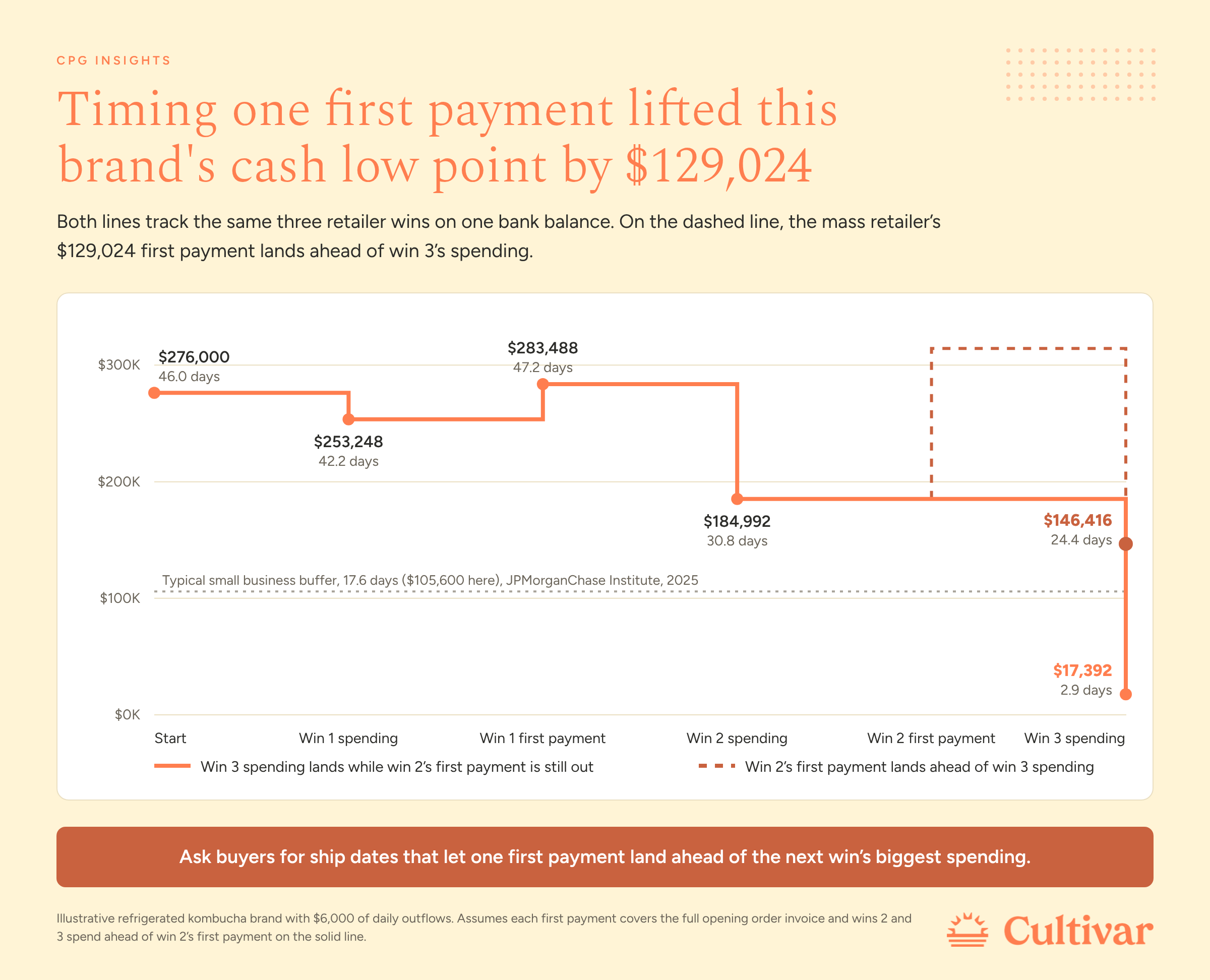
When retailer wins overlap, their dips stack on one bank balance. The next win’s cash goes out while the last win’s first payment is still on its way. In the example, the club order lands during the mass retailer’s wait. The bank balance bottoms out at $17,392, or 2.9 days of outflows.
Ashley described exactly this moment at Prevail, when “all of these things were kind of hitting all at the same time.”
One bank balance, three wins
| Checkpoint | Cash change | Bank balance | Buffer days |
|---|---|---|---|
| Start | $276,000 | 46.0 | |
| Win 1 low point | −$22,752 | $253,248 | 42.2 |
| Win 1 first payment | +$30,240 | $283,488 | 47.2 |
| Win 2 low point | −$98,496 | $184,992 | 30.8 |
| Win 3 spending lands on top | −$167,600 | $17,392 | 2.9 |
Two assumptions sit under this table, and I want them in plain view. Every dollar of the win 2 and win 3 dips leaves ahead of win 2’s first payment. Each first payment also covers the full opening order invoice.
Now watch what happens when the timing changes. Say the mass retailer’s $129,024 first payment lands ahead of the club spending. The low point becomes $146,416 ($184,992 + $129,024 − $167,600), or 24.4 days. The same three wins with different timing leave $129,024 more in the bank at the low point. For reference, the typical small firm’s 17.6 buffer days would equal $105,600 at this brand’s $6,000 a day.
Spirit Tea’s Co-Founder, Jordan Scherer, felt that same pull between sales and cash. He told Cultivar “My bank balance isn’t growing the way I’d expect it to.” The story behind Spirit Tea’s bank balance covers the cash flow forecast Cultivar built for him. It helps him plan runway, headcount, and working capital, with a flexible line of credit still in progress. When two first payments are still out at once, I slow down and check the low point with the Founder line by line.
How Do I Size the Cash Dip for a New Retailer?
Size the cash dip for a new retailer by adding the production cash and launch spend you’ll pay during the wait. Add any new monthly costs for each month until the first payment lands. Take that dip, and any dips still open, off your bank balance. Then divide by your average daily outflows to read the low point in cash buffer days.
Illustrative win 2, $55,296 + $35,200 + ($3,200 × 2.5) = $98,496.
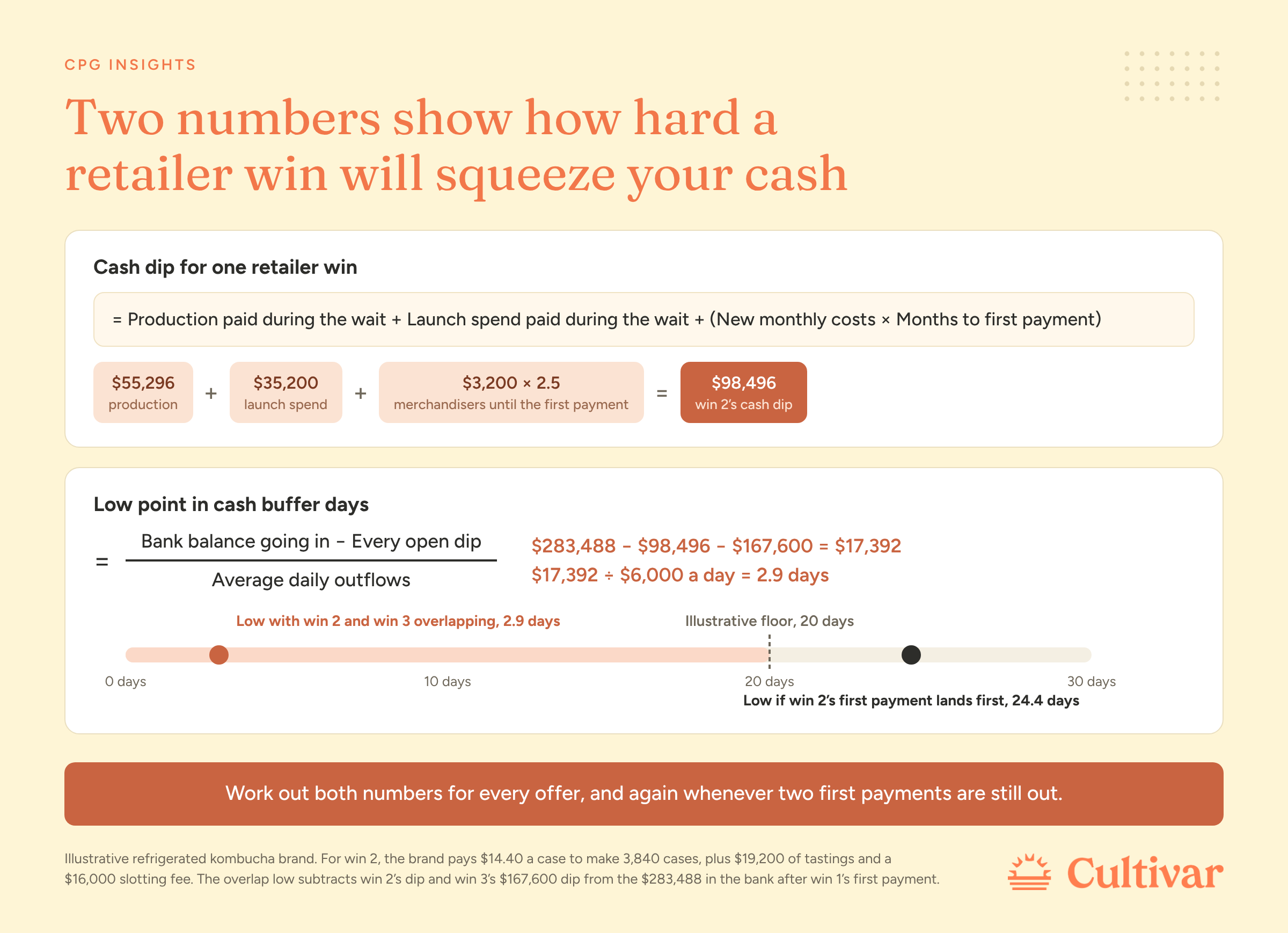
Every input comes off paperwork you already hold. You’ll use the buyer’s program, the co-packer’s quote, your launch budget, and the forecast’s list of first payments still due. In the formula, win 2’s merchandisers count as a new monthly cost. That leaves its launch spend line with $19,200 of tastings and $16,000 of slotting, or $35,200.
Then set a floor, the lowest balance you’re willing to reach, measured in buffer days. The Coleman Report covered the same JPMorganChase figure in its piece on small business cash reserves. It explains that buffer days measure how long a business could maintain its average outflows. Use that as context, because every Founder’s gotta pick their own floor.
Our example uses an illustrative floor of 20 days, or $120,000 ($6,000 × 20). That floor sits $102,608 above the overlap low ($120,000 − $17,392). It also sits $26,416 below the sequenced low ($146,416 − $120,000). The $102,608 is the gap a plan has to close. Ship-date sequencing, supplier terms, working capital financing, or some mix of them can close it.
Our scenario modeling for CPG brands is where I model each offer as its own scenario in the brand’s forecast. Each scenario carries its PO date, first payment date, new monthly costs, and dip. The Founder sees the low point while the buyer waits for an answer.
How Should I Plan Cash for My Next Retailer Win?
Plan cash for your next retailer win by timing its spending around first payments already due. Settle supplier terms early, and update your forecast every week of the wait. Cultivar’s view is that every retailer yes deserves a dip number in buffer days. The timing of your wins can move your low point as much as their size.
Three habits shape how I plan with every Founder.
- I ask buyers for ship dates that let one first payment land ahead of the next win’s biggest spending. I make that ask whenever the buyer has room to move.
- I settle co-packer and packaging terms early, and I treat a request like weekly payment as a partnership conversation. Glenn approached it the same way, saying, “We were trying to form a partnership with them.” He added, “It was a big strain on us. It was a big strain on them.”
- I update the forecast weekly with each win’s real spend and payment dates, so the low point always reflects the latest numbers.
Owen described the other half of the picture on the webinar. He said “In a growing business, you don’t want cash lying idle. You want to put it to work all the time.” Your floor is what lets cash work hard with confidence, because you know exactly how low it can go. Treat working capital for retail expansion as part of every offer you accept. Then bring a lot of ganas, the Spanish word for drive, to your next buyer meeting.
If a bigger retailer just said yes, I’d love to size the dip in your bank balance with you, win by win. Talk to me and the Cultivar team.
Frequently Asked Questions
Why Do Co-Packers Change Payment Terms for Large Retail Orders?
Co-packers change payment terms on large retail orders when the order strains their own labor and cash. Glenn said Prevail’s production facility asked for weekly payment because “they had to hire temp help for the order. They were giving guys overtime.” Ask your co-packer early what a bigger run would cost them, so any change in terms shows up in your forecast on day one.
Should I Turn Down a Big Retailer If the Cash Dip Looks Too Deep?
Keep the big retailer on the table until you’ve sized the dip and tested your options against it. Glenn called wins like Costco opportunities “you can’t pass up,” and he added “you also got to try to not bite off more than you can chew at the same time.” Prevail said yes once the team felt confident it could carry the order.
Can Working Capital Financing Cover the Cash Dip on a Big Retail Order?
Yes, working capital financing is designed to cover the stretch between paying for a big order and collecting on it. Speaking as one lender, Owen of Wayflyer described that role as “filling that gap between the initial payment that’s made and the receipt of your payment at the end.” Line up that conversation while the offer is still open, so the money is ready for the co-packer’s first bill.
Why Is My CPG Brand Profitable but Low on Cash?
Your CPG brand can be profitable and low on cash because profit shows up on each sale while its cash sits in inventory and unpaid invoices. Pedro said a growing brand can look “all rainbows and sunshine” to everyone outside, while the bank balance tells the inside story. Compare your P&L with your cash flow statement each month to see exactly where the profit is waiting.
Related Resources
- Cultivar’s CPG trade spend tracking logs, categorizes, and verifies every chargeback and deduction, and shows how trade spend affects cash flow and margins.
- Pedro’s cash conversion cycle case study follows a scaling sauce brand whose 139-day cash conversion cycle left it out of pocket, and the plan projected to bring it under 100 days.
- Our case study on Pistakio’s runway model shows the three-statement financial model Cultivar built during Pistakio’s retail growth, giving its Co-Founder visibility into runway, growth targets, and fundraising needs.
About the author
Maggie Ojeda
Financial Account Manager, Cultivar · Executive MBA, IAE Business School · FP&A for Napa Valley wineries and US CPG brands
Magdalena (Maggie) Ojeda is a Financial Account Manager at Cultivar. She joined Cultivar in 2024 as a Senior FP&A Consultant and went on to lead its US financial planning and analysis (FP&A) team as FP&A Manager. She brings more than 10 years of finance experience, including roles at Accenture, P&G, and Grupo Peñaflor, one of Argentina’s top wine producers, where she spent four years in winemaking cost control. Maggie specializes in FP&A for Napa Valley boutique wineries and US CPG brands. She earned her economics degree at Universidad Nacional de Cuyo and her Executive MBA at IAE Business School, and she has mentored Founders in the SKU accelerator.
