Key Takeaways
Two versions of the same $1.5 million snack brand can show a lender gross margins of 50.0% and 40.0%, and the only difference between them is how QuickBooks was set up.
Coding $210,000 of trade spend as contra-revenue brings the example brand’s gross margin down to 41.9%, and the article names the four accounts to set up for it.
In the article’s April example, cash basis books show a 100% gross margin while accrual books show 60%, and accrual books are the ones that make margin comparable month to month.
Recording $40,000 of open distributor deductions as reductions of revenue lowers the example’s debt service coverage ratio to 1.17, which lands under the 1.25 many banks ask for.
The pre-application cleanup takes four checks, and the last one is a scan of the QuickBooks Online audit log for edits you don’t recognize.
Two versions of the same snack brand apply for a CPG business loan in the same week. Both sold $1,500,000 of product last year, used the same co-packer, paid the same freight rates, and ran the same promotions through the same distributors. One shows the lender a 50.0% gross margin and a 1.50 debt service coverage ratio. The other shows a 40.0% gross margin and a 1.17 ratio, which lands below the 1.25 many banks and credit unions ask for. The only difference between them is how each QuickBooks file was set up.
I’m Sandra Velásquez Ochoa, an Accountant at Cultivar and a public accountant with more than 15 years in manufacturing finance and administration. For eight of those years I led the department as administrative and financial manager at Comestibles Mapy in Colombia, where I built the budgets, forecasts, and cash flow plans and negotiated credit terms with our banks. I know exactly which lines a lender’s eyes go to first, and I still get a little giddy when one reclassified account moves a margin.
What Does a Lender Read in Your QuickBooks File?
Lenders deciding on a CPG business loan read the three reports your QuickBooks file produces, meaning the profit and loss statement (P&L), the balance sheet, and the cash flow statement. Then they calculate ratios such as the debt service coverage ratio (DSCR) on top of those reports. When I negotiated credit conditions with banks in Colombia, every meeting opened with those three reports and closed with one ratio. The FDIC’s 2024 Small Business Lending Survey found that nine in ten small banks have loan decision-makers meet with applicants. Under one bank in a hundred will auto-approve a $250,000 loan, so expect a human being to read your statements line by line.
DSCR divides net operating income, the profit your business makes before interest and taxes, by your total annual loan payments, which lenders call debt service. At 1.50, that profit covers the year’s loan payments one and a half times over, and I’d take that piece of math over a crossword any day.
| Debt service coverage ratio |
|---|
= Net operating income ÷ Total annual debt service |
Our example brand books $1,500,000 in gross sales. After $750,000 of cost of goods sold, $210,000 of trade spend, and $360,000 of other operating expenses come out, $180,000 of net operating income is left. Its existing loan costs $30,000 a year and the proposed loan would add $90,000, so debt service is $120,000 and the DSCR is 1.50. Banks and credit unions often ask for a DSCR of 1.25 or greater, so 1.50 reads as comfortable for now. Work your own ratio with the new loan’s payments included, because the lender will.
| Line | Amount |
|---|---|
| Gross sales | $1,500,000 |
| Cost of goods sold | $750,000 |
| Trade spend | $210,000 |
| Other operating expenses | $360,000 |
| Net operating income | $180,000 |
| Existing annual loan payments | $30,000 |
| Payments on the proposed loan | $90,000 |
| Total annual debt service | $120,000 |
| DSCR ($180,000 ÷ $120,000) | 1.50 |
How Do You Set Up QuickBooks for a CPG Business Loan?
Setting up QuickBooks for a CPG business loan starts with how you structure your CPG chart of accounts. That list decides which lines appear on your P&L and which margins a lender can read without emailing you a question.
Four groups of accounts put gross margin on the page exactly where a lender expects to find it, and they make QuickBooks for CPG brands readable in one sitting:
Revenue accounts by product type, such as beverages and snacks, so each revenue line has a matching cost of goods sold line, with sales channels tracked through classes.
Contra-revenue accounts for trade spend, which sit under revenue and reduce it, so net revenue appears as its own line.
Cost of goods sold split into ingredients, packaging, co-packer fees, and freight-in, so you and the lender can see which input moved the margin. Freight-in is the shipping you pay to get ingredients and packaging to your co-packer.
Your item list, which QuickBooks calls Products and Services, so each product knows which income, cost of goods sold, and inventory asset accounts to post to.
Class tracking adds a tag, such as a sales channel, to every transaction, including the costs. On QuickBooks Online Plus and Advanced, that tag produces a P&L for each channel, which is the report a lender wants when it asks how each channel performs after expenses. At Cultivar we build every client’s QuickBooks starting at the chart of accounts and the item list, and it’s my favorite week of any onboarding. Books built in that order are ready to scale and ready for working capital financing before anyone asks for a report.
How Does Your Inventory and COGS Setup Change Your Gross Margin?
Accrual basis accounting records cost of goods sold in the same month as the sale, while cash basis books record a co-packer bill on the day you pay it. The two methods report different gross margins for identical months. The IRS defines the cash method as reporting income in the year you receive it and expenses in the year you pay them. It defines the accrual method as reporting income when you earn it and expenses when you incur them. Businesses that carry inventory generally have to use an accrual method for purchases and sales. Small business taxpayers get an exception that most brands at your revenue size qualify for, so ask your tax preparer which method your return uses.
Production costs belong in an inventory asset account on the balance sheet until the product sells, which is where ingredient invoices, packaging, freight-in, and co-packer fees wait their turn. Cultivar reengineered the chart of accounts behind the ¡Ya Oaxaca! inventory tracking rebuild to support inventory tracking and automation at scale. QuickBooks Online puts its inventory features on the Plus and Advanced plans. Any single report can be switched between cash and accrual basis in its own settings without touching the company-wide default.
| Gross margin |
|---|
= Net revenue − Cost of goods sold ÷ Net revenue |
In March you pay your co-packer $60,000, and in April you sell product that cost $40,000 to make for $100,000 and collect the cash the same month.
| Line | Cash basis | Accrual basis |
|---|---|---|
| March sales | $0 | $0 |
| March cost recorded | $60,000 | $0 |
| March result | $60,000 loss | $60,000 moved into inventory |
| April sales | $100,000 | $100,000 |
| April cost of goods sold | $0 | $40,000 |
| April gross profit | $100,000 | $60,000 |
| April gross margin | 100% | 60% |
| Inventory on the balance sheet at the end of April | $0 | $20,000 |
Accrual books make your margin comparable month to month. That 100% CPG gross margin in April looks like a miracle, and lenders don’t underwrite miracles. Any month showing one is a sign the reports need adjusting before a lender relies on them, and it’s the first thing I check in a new client’s file.
Where Should Trade Spend and Deductions Live in QuickBooks?
Trade spend and deductions belong in contra-revenue accounts, because payments to retailers and distributors generally reduce your revenue, and coding them there shows a lender your real net revenue and gross margin. Under ASC 606, the US revenue recognition standard, a payment to a customer reduces revenue unless your brand receives a distinct good or service in return. So a slotting fee, the payment a retailer charges to place your product on its shelf, comes off the top line, and so does a promotional allowance. Each deduction should trace back to a term you agreed to in a distributor or retailer program, and good trade spend accounting gives each type its own contra-revenue account. I recommend four at a minimum, for slotting fees, promotional allowances, manufacturer chargebacks, and short-payments. Chargebacks are the promotional discounts a distributor bills back to you, and short-payments are the amounts it takes off an invoice when it pays.
Our example brand spent $210,000 on trade last year. Coded as marketing expense, the file shows revenue of $1,500,000, gross profit of $750,000, and a 50.0% gross margin. Coded as contra-revenue, the same year shows net revenue of $1,290,000, gross profit of $540,000, and a 41.9% gross margin. Net operating income stays at $180,000 either way, because the dollars moved up the P&L without leaving it.
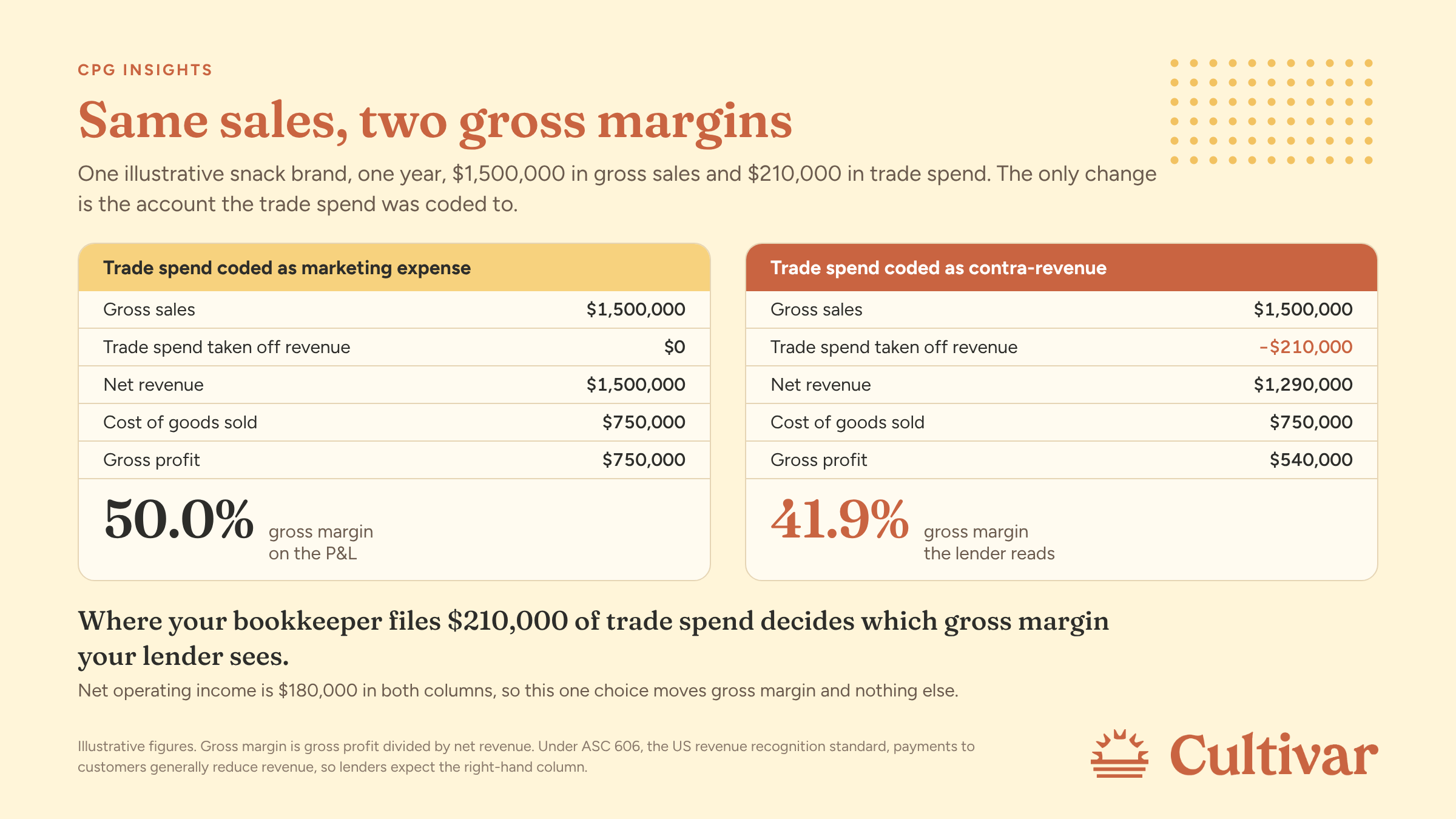
Share this with your bookkeeper and check which column your QuickBooks file matches.
Now record the $40,000 of distributor deductions still sitting in accounts receivable, the money customers owe you, as reductions of revenue. Net revenue falls to $1,250,000, gross margin to 40.0%, net operating income to $140,000, and the DSCR to 1.17, below the 1.25 benchmark. I’d hand a lender the 40.0% column every time, because it agrees with the remittance advice your distributors send with each payment and survives the lender’s first question.
| Line | Trade spend coded as marketing expense | Trade spend coded as contra-revenue | Contra-revenue plus $40,000 of open deductions recorded |
|---|---|---|---|
| Gross sales | $1,500,000 | $1,500,000 | $1,500,000 |
| Trade spend and deductions taken off revenue | $0 | $210,000 | $250,000 |
| Net revenue | $1,500,000 | $1,290,000 | $1,250,000 |
| Cost of goods sold | $750,000 | $750,000 | $750,000 |
| Gross profit | $750,000 | $540,000 | $500,000 |
| Gross margin | 50.0% | 41.9% | 40.0% |
| Net operating income | $180,000 | $180,000 | $140,000 |
| DSCR on $120,000 of debt service | 1.50 | 1.50 | 1.17 |
What Should Your QuickBooks Cleanup Cover Before You Apply?
Your pre-application QuickBooks cleanup confirms that every balance a lender reads agrees with your bank, your card statements, your customers’ remittances, and your own records. It’s a one-time pass that sits alongside your regular monthly close. Reconciling is the part I find weirdly soothing, because every matched transaction is one less question a lender can ask. Undeposited funds, labeled Payments to deposit in newer QuickBooks Online files, is the holding account for customer payments that haven’t been matched to a bank deposit yet. When I do this pass for a client, it’s where the surprises hide.
Our CPG accounting services reconcile sales across Shopify, Amazon, distributors, and more every month and prepare presentation-ready financials for lenders. Four checks make up the pass we do before any client’s application goes out:
Reconcile every bank and credit card account through the latest month-end, matching each QuickBooks transaction to its line on the statement until the two balances agree.
Clear old undeposited funds by matching each customer payment to the real bank deposit it arrived in.
Record every open distributor deduction as a reduction of revenue, so accounts receivable shows only the money you’ll collect.
Scan the QuickBooks Online audit log for edits you don’t recognize. It records sign-ins, settings changes, transaction edits, and changes to customers and vendors, it can’t be switched off, and it holds two years of events.
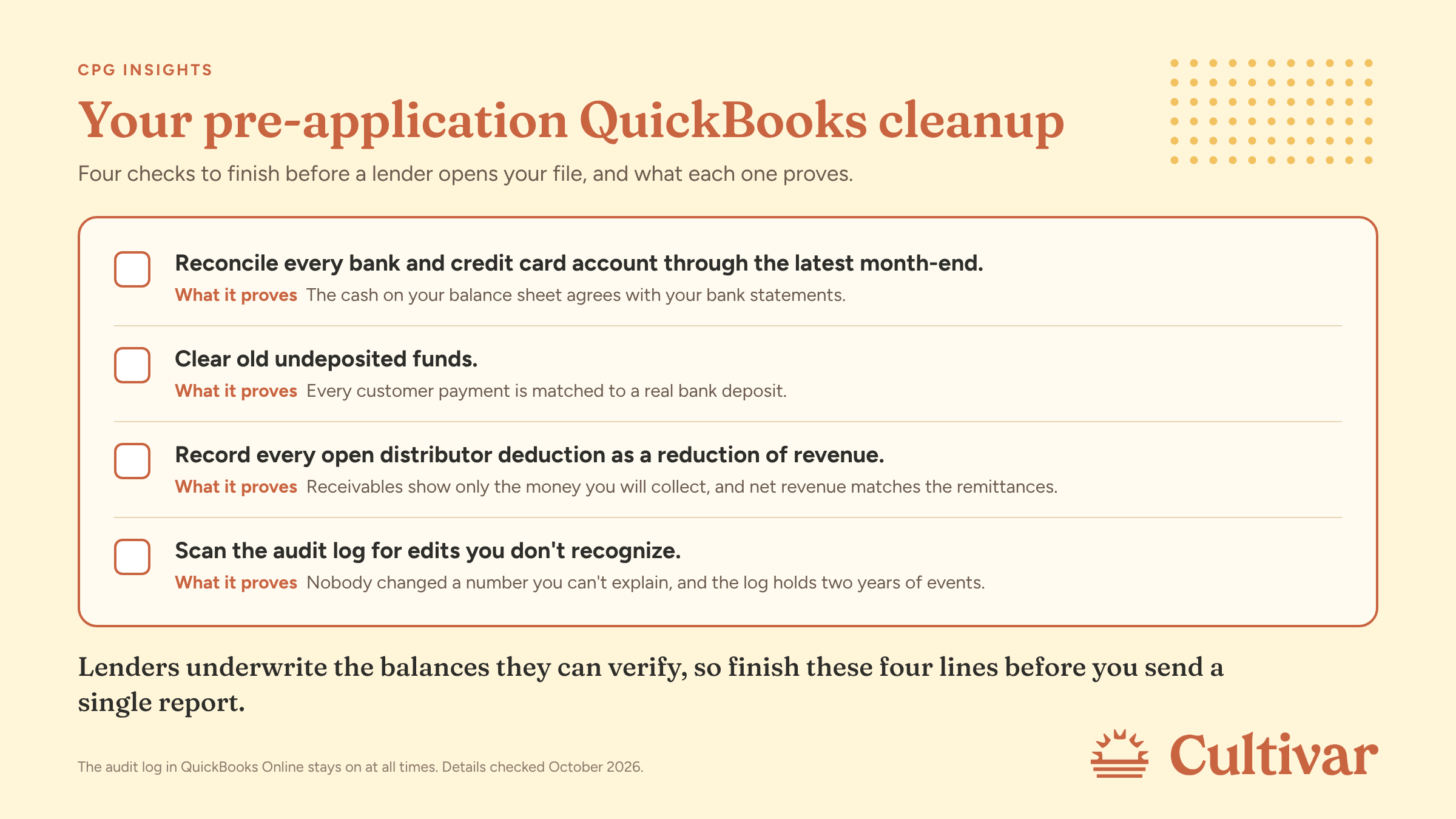
Save this checklist and check off every line before your lender opens your QuickBooks file.
Which Lenders Read Your QuickBooks Data Directly?
Some lenders pull your QuickBooks data straight into underwriting, the review that decides if you’re approved and on what terms, while others ask for financial statements built in the same file. QuickBooks Term Loan is issued by WebBank in partnership with QuickBooks Capital. Its underwriting considers your QuickBooks history, your business bank account activity, your revenue, and your current liabilities. It also weighs the credit history of the business and of its personal guarantor, the owner who promises to repay if the business can’t. Businesses with generally at least $50,000 in revenue over the past 12 months may qualify, and applicants should have no personal or business bankruptcies in the last two years. Loans start at $1,500 with terms of 6 to 24 months.
QuickBooks Line of Credit is also issued by WebBank and offers advances on eligible unpaid invoices. Eligible means invoices of $258 or more sent through QuickBooks that are unpaid and no more than 30 days past due. Cash draws are available to applicants who meet the lender’s criteria, and the product requires a QuickBooks Online subscription. I checked those terms in October 2026, and they change, so confirm them again the week you apply.
Every setup choice above feeds those reads directly. An underwriter pulling your QuickBooks history can see your contra-revenue accounts, your inventory asset, your undeposited funds balance, and your reconciliations exactly as you left them. Lenders outside QuickBooks ask for statements built in the same file, so a CPG business loan application at your local bank rests on the same choices.
What Does a Lender See Once Your QuickBooks Setup Is Fixed?
Once your QuickBooks setup is fixed, a lender sees a gross margin and DSCR that agree with your bank statements, your distributor remittances, your inventory count, and your own forecast. The numbers it calculates become the ones you planned around. On our example brand, the chart of accounts put trade spend under revenue, and the accrual method put cost of goods sold beside the sales it produced. The deduction entries moved $40,000 out of receivables, and the reconciliations matched cash to the bank. Together they turned a 50.0% margin and a 1.50 DSCR into a 40.0% margin and a 1.17 DSCR that a lender can verify line by line. Those corrected numbers came out lower, and they’re numbers you and your lender can both trust.
Founders ask me if Cultivar really works only with CPG brands, and the answer is yes. Food and beverage accounting is the whole job for my team, including every setup choice in this article. If a lender has already said no, these same fixes set up a stronger next application, and an equity investor will ask to see these exact books at your next raise.
Talk to Cultivar’s CPG accounting team before you apply for your next loan.
Frequently Asked Questions
Do Lenders Accept QuickBooks Financial Statements Without a CPA Review?
Many lenders accept internally prepared QuickBooks statements for smaller requests when the tax returns and bank statements you send alongside agree with them. Larger requests often call for statements a CPA has compiled or reviewed, which puts an outside accountant’s name on the numbers.
How Many Years of Financials Do Lenders Want to See for a CPG or Wine Brand?
Expect to show at least 12 months of the profit and loss statement, balance sheet, and cash flow statement, ideally 18 to 24. Add tax returns for the last year or two and a current year-to-date set.
Can I Switch QuickBooks Online to Accrual Basis in the Middle of the Year?
Yes, because the accounting method in QuickBooks Online is a reporting setting. Any report can be set to accrual basis today as long as your bills, invoices, and inventory items are entered, and the company default changes under Account and settings. Changing the method on your tax return is a separate step that generally needs IRS Form 3115, so talk to your tax preparer before you file.
Should I Give My Lender Direct Access to My QuickBooks Account?
Invite a lender as a reports-only user, which QuickBooks Online Plus and Advanced include without counting toward your user limit, or export the statements it asks for. Never share your own login with anyone.
Related Resources
Cultivar’s CPG trade spend management service tracks, categorizes, and verifies every distributor deduction and chargeback.
Pedro’s post on the questions lenders ask CPG brands picks up once your reports are on the table.
The Hudson Vineyards chart of accounts rebuild separated winery, vineyard, and custom crush lines and moved vineyard costs above the gross margin line.