Some Founders build to hold, and I'm happily one of them, so if you're locked in for good, every calculation below is still relevant. If an exit is on the horizon someday, pay close attention. Your business exit strategy starts taking shape at your first raise. Bring a fork, because we're about to tuck into the numbers together.
Barilla Group, a pasta company, agreed in early September 2026 to acquire Goodles, a mac and cheese brand. Neither company disclosed a price, but the last public valuation was $88 million, as reported by The Wall Street Journal after Goodles' 2023 round.
Barilla's deal for Goodles and Unilever's deal for Grüns show five decisions in order, starting with picking a category the incumbents hadn't reformulated, then proving incremental demand, raising only what the plan needs, reaching profitability before a buyer calls, and finally learning what each buyer values. I’m Cultivar’s CEO and Founder, and I mentor emerging CPG Founders on finance and accounting and on fundraising through SKU, a CPG accelerator.
The Business Exit Strategy Behind Barilla's Deal for Goodles
Who Barilla Is and What Stays in Place
Barilla is a strategic buyer, meaning a food or consumer goods company that acquires a brand to add to its own portfolio and distribution network. Founded in 1877 and family-owned through its fourth generation, Barilla approached Goodles in June 2026, according to The Wall Street Journal. Goodles started as Gooder Foods in October 2020 and launched in late 2021.
After closing, Goodles stays in Santa Cruz with CEO Jen Zeszut and its full team, and it controls its product, recipes, ingredients, suppliers, and marketing, so a business exit strategy can leave a Founder's team in place.
Read a Revenue Multiple Before You Quote One
Price divided by annualized run rate, which is one month of revenue multiplied by 12, gives a revenue multiple. Axios reported a $1.2 billion price for Grüns in April 2026, which Unilever’s announcement didn’t confirm, and Grüns said in October 2025 that its annualized run rate had passed $300 million that August.
$1,200,000,000 ÷ $300,000,000 = 4.0x
That pairs an April 2026 price with a revenue figure about eight months older, and because the run rate was above $300 million and still growing, the multiple on that reported price sits under 4.0x. Grüns’ reported revenue also moved fast, with nine-figure annual recurring revenue, meaning at least $100 million a year, disclosed in May 2025 and a run rate above $300 million by that August, so any multiple depends on which month you pick.
Set Your Exit Target
Write down if you want to sell, when you'd like to, what kind of buyer fits, and what number would feel right, so the rest of this article has a target.
Pick a Category the Incumbents Hadn't Reformulated
How Goodles Entered the Category
Goodles is a challenger brand, meaning a smaller brand that wins sales against a category's established leaders. It entered shelf-stable mac and cheese in 2021 with 14 grams of protein per serving. Its founders said at launch that the category had seen little innovation in decades, even though Kraft had already swapped synthetic dyes and artificial preservatives for spices in 2015.
Track the Share Gain in Dollar Share
Dollar share is the percentage of category spending, in dollars, that one brand captures over a set period. Numerator data reported by The Wall Street Journal tracks Goodles' mac and cheese share gain in U.S. shelf-stable spending across the 12 months through June 2026 against the same months three years earlier.
Goodles held 0.8% three years earlier and 7.8% in the latest 12 months, a gain of 7.0 points (7.8 minus 0.8).
Kraft Mac & Cheese held 42.2% three years earlier and 36.6% in the latest 12 months, a drop of 5.6 points.
Velveeta held 21.6% three years earlier and 18.9% in the latest 12 months, a drop of 2.7 points.
Kraft Mac & Cheese and Velveeta, both Kraft Heinz brands, lost 8.3 points together (5.6 plus 2.7).
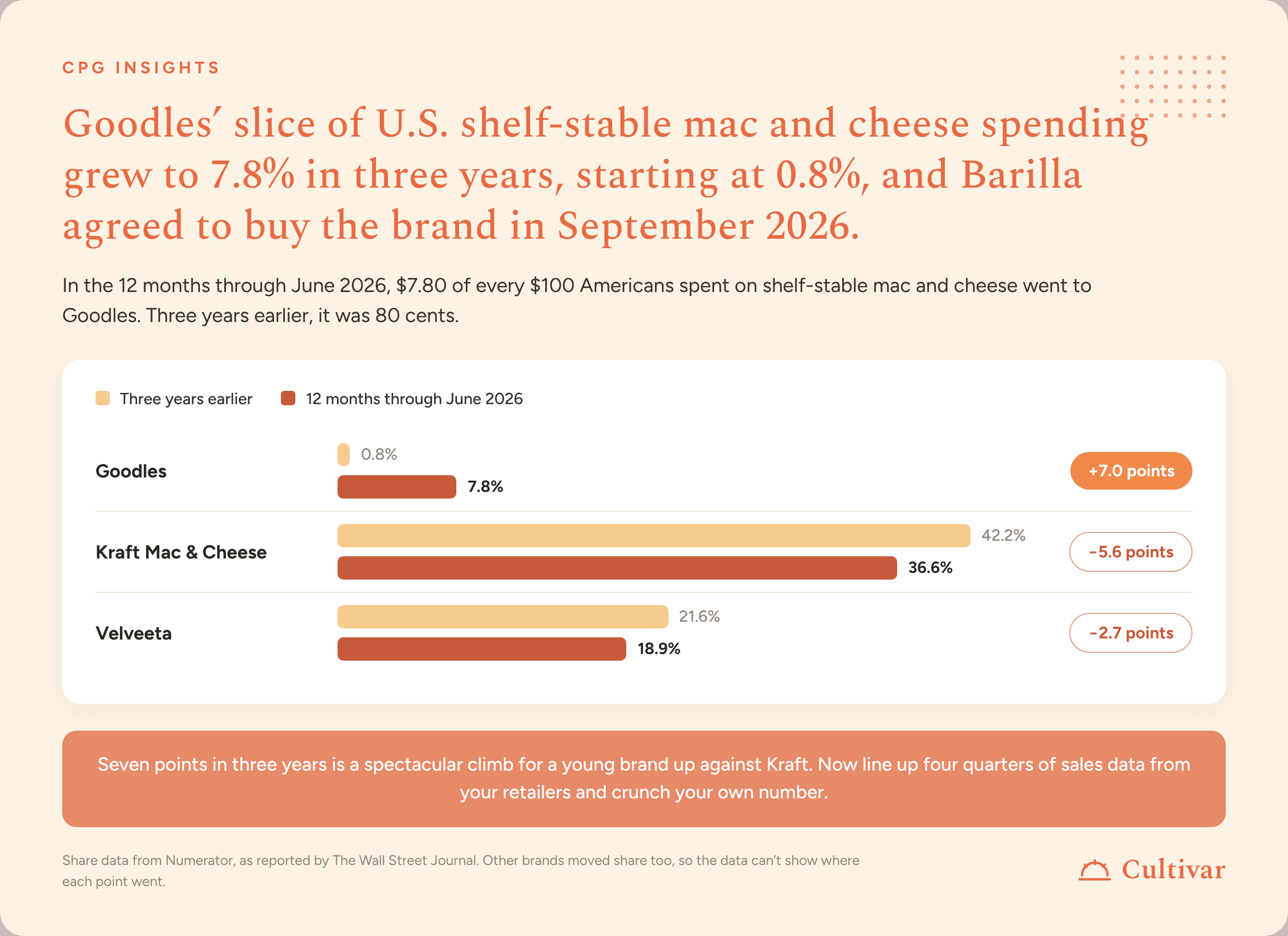
Y'all, I love how close Goodles' 7.0-point gain sits to the 8.3 points those two Kraft Heinz brands lost. Other brands moved share too, so the data can't tell us where each point went. Seven points of share in three years is a spectacular result for a brand that launched in November 2021.
How the Incumbents Answered
Annie's already sells Super! Mac with 15 grams of protein and 6 grams of fiber per serving, and Kraft's PowerMac, announced in March 2026 and on shelves in April with 17 grams of protein and 6 grams of fiber, is the category leader's answer, so the 2021 opening has closed.
Calculate Your Own Share Change
Share change equals ending share minus starting share, and multiplying it by category dollars gives annual retail dollars gained. In a $50 million category, a brand with 1.0% share, worth $500,000, that reaches 4.0%, worth $2,000,000, gains 3.0 points, worth $1,500,000 a year in retail sales. Pull four quarters of your own retailer scan data and calculate your share change.
Prove Incremental Demand That Retailers Can Measure
Incrementality in Plain Terms
Incrementality means sales a retailer wouldn't have made without your product, shown at store level as buyers who are new to that category there.
What Goodles' Retailer Data Showed
Jen Zeszut told Food Business News on March 4, 2026, that 84% of Goodles buyers at one mass retailer had never bought mac and cheese there before, with 81% at another mass retailer and 80% at a club customer, all company-reported in a single interview, with no retailers named. If 80 of every 100 buyers at a retailer are new to mac and cheese there, that's an 80% incrementality figure, and turning it into dollars means assuming those 80 spend like existing buyers, which the data doesn't confirm.
What Grüns Shows About Repeat Purchase
The Grüns acquisition shows the same principle through purchase frequency. Grüns launched in August 2023 and passed a $300 million annualized run rate in August 2025, its 24th month. It closed with Unilever on June 1, 2026, and sells through Sprouts, Target, Walmart, Costco, and Sam’s Club. Grüns says 95% of users take it at least four to six times a week and 80% take it daily, based on its own survey of more than 3,000 customers.
Pull your retailer and loyalty program data, plus any DTC data you have, to find the share of your buyers who are new to the category and how often they buy again.
Raise Only What the Plan Needs and Reach Profitability Before a Buyer Calls
How Goodles Used Its Capital
Raising money gets all the attention. Capital efficiency, which is how much revenue and profit a brand produces for each dollar of outside capital, decides if a brand is still standing when a buyer calls. Goodles announced $19.4 million across two rounds, $6.4 million at its 2021 launch and the $13 million Series A in 2023, and CB Insights counts $26.39 million across six rounds. L Catterton led that Series A in September 2023, and The Wall Street Journal reported that Goodles turned its first profit in 2024, two years before Barilla called.
Calculate Your Percent Sold
Post-money valuation is a company's value before a round plus the new money, and percent sold, also called dilution, equals new money divided by post-money valuation.
Treating the $88 million valuation as post-money, $13,000,000 ÷ $88,000,000 = 0.1477, or about 14.8% sold.
As an illustration, $2 million at an $8 million post-money valuation sells 25%, and at $10 million sells 20%.
Plan Every Round Before You Raise It
Planning a round starts with the cash your plan actually needs, and I tell the Founders I mentor through SKU to raise only that amount, because every round reshapes your business exit strategy.
To size that number, start with a roadmap to profitability, which shows how to build the plan into your financial model. For a bit of inspo, take a look at Alec's Ice Cream's equity raise, which describes the three-statement model Cultivar built for the company and the $11 million equity raise it closed. Before you open your next round, list every round you've raised with its date, amount, post-money valuation, and percent sold, so you know how much of the company you've already sold before you sell more.
Know What Each Buyer Values, From a Family Company to a Public Portfolio
How Barilla and Unilever Differ as Owners
Barilla is a private family company that sells in more than 100 countries and has committed to leaving Goodles independent, which is the kind of ownership I call patient capital. Unilever, a public company, completed the Grüns deal on June 1, 2026, and placed Grüns in its Wellbeing business, describing the purchase as a step toward premium and high-growth spaces with a stronger focus on Beauty & Wellbeing and the U.S. market.
Unilever also agreed on March 31, 2026, to combine its Foods business with McCormick, a deal it expects to complete by mid-2027, subject to McCormick shareholder approval, and which will leave Unilever operating across Beauty, Wellbeing, Personal Care, and Home Care. Different buyers write different endings into your business exit strategy, so learn what each one values before you take a meeting.
What Unilever's Filing Shows About the Grüns Deal
Unilever's SEC filing on Grüns, its July 2026 half-year report, shows that Unilever acquired 80% of Grüns on June 1, 2026, for €767 million and recognized a minority buyout liability, which is the amount a buyer records for its future obligation to buy the original owners' remaining 20%.
Dividing €767 million by 0.80 gives an implied €958.75 million for 100% of Grüns, or about $1.12 billion at the $1.167-per-euro average rate Unilever reported for the first half of 2026.
Model an 80/20 Payment Structure
At a $100 million valuation, a buyer pays 80% × $100 million, or $80 million, at closing, and the remaining 20%, worth $20 million, arrives later under terms set in the purchase agreement. The $100 million value is illustrative, while the 80/20 split mirrors Grüns' deal. The price of the remaining 20% depends on terms negotiated at the start, and our CPG financial planning services help you model them in your forecast. Build a forecast case with 80% paid at closing and 20% later.
Start Your Business Exit Strategy at Your Next Raise
If you're wondering how to get acquired, start with two numbers you can calculate this week, which are percent sold across every funding round and your dollar share change over the last four quarters. Both numbers serve Founders who plan to hold on to their brand too. At Cultivar, we treat exit planning, fundraising, trade spend, and cash flow as one conversation, because each one changes the numbers a buyer will test.
Bring Your Numbers to Cultivar's CPG Finance Team
If you're planning a raise or thinking about a sale, bring your numbers to Cultivar's CPG finance team and we'll work through them. I know you've got the ganas to build something a buyer will want, and I'd love to help you get your books, forecast, trade spend data, and cap table ready for a buyer's or investor's questions.
You'll leave the call with the following.
Your percent sold across every funding round, calculated together and checked against your cap table.
Your dollar share change over the last four quarters, built on your own retailer data.
Your forecast case showing how an 80/20 payment structure would move cash into your account over time.
The first questions a buyer's or investor's team would ask about your numbers, so you can answer them before anyone asks.
Book your exit-readiness call and bring your funding history along with the last four quarters of your retailer data.
FAQs
How Much Revenue Does a Food or Beverage Brand Need Before a Strategic Buyer Will Look at It?
Buyers weigh growth and margin alongside revenue, so thresholds vary by buyer and category. Goodles had turned a profit in 2024 and lifted its dollar share by 7.0 points, to 7.8%, over three years by the time Barilla approached in June 2026. Calculate your own dollar share change using four quarters of retailer data, along with your gross margin, because those two numbers show a buyer where you stand.
What Is a Quality of Earnings Report, and Does a Small CPG Brand Need One Before Selling?
Quality of earnings reports are independent reviews that test how well a brand's adjusted earnings and working capital hold up once one-off items and deductions come out. Buyers commonly request one during diligence, and its findings can change the price they offer. Smaller brands can commission their own before a sale to surface trade spend and deduction problems before a buyer finds them.
Do I Need an Investment Banker to Sell My CPG Brand?
Goodles hired a financial advisor and a legal advisor for its sale to Barilla. An advisor tends to earn the fee when several bidders compete or when the payment is split, as in Grüns' 80/20 structure, so count the offers you realistically expect before you hire one.
How Do Earnouts and Holdbacks Work When a Food or Beverage Brand Gets Acquired?
Earnouts pay part of the price later if targets are met and holdbacks reserve part at closing to cover claims, so both delay part of your payout the way the $20 million does in the 80/20 example. Model both in the same forecast case you built for the 80/20 split.
Related Resources
Loan support for CPG brands explains how lender-grade financials open non-dilutive capital.
Working versus non-working trade shows how non-working trade ends up funding the distributor's inside margin.
The 40-day cash conversion cycle cut follows a client with 39.3 months of runway and a 139-day cycle, projected to fall under 100 days.