Deduction Clearing Companies: Why Paying for One Can Be Cash-Positive
Here's a scene I'd bet y'all know. The UNFI or KeHE payment lands, and the remittance that comes with it is page after page of codes nobody ever taught you to read. Your remittance itemizes the payment and every deduction taken from it, and the check is smaller than the invoices it pays.
Deduction management services, offered by deduction clearing companies, read those pages for you, match each deduction to your invoices and contracts, and dispute the ones that look wrong. Founders ask me whether it makes sense to pay somebody to get their own money back, and I light up every time, because it's a question you can answer with two formulas and your own remittances.
My guide here is Fred Schroeder, who joined me for our trade spend webinars (May 6 and August 19, 2026) and who I introduced on the August call as a legend in trade spend and deductions. Fred worked at Procter & Gamble and Coca-Cola's Minute Maid division, then led two trade promotion software companies.
Today he advises small brands one to one and in groups, dissecting their gross-to-net P&L retailer by retailer and distributor by distributor, and he told the August webinar "I am system agnostic as I work with brands," meaning he works with whichever provider a brand already uses, so his read on this category comes with no sales pitch attached.
What Deduction Management Services Actually Do
What Happens to Your Remittance
On the May webinar Fred said a clearing company "takes the 90 pages of nonsense," meaning a raw remittance, "and organizes it and puts it into very readable and digestible reports and analyses." He added that it "also takes the distributor reports and puts those into the analysis as well in many cases," meaning the sales reports your distributor charges you for.
Why One Distributor System Makes Them Fast
Their speed comes from specializing, because UNFI and KeHE, the two major distributors for natural and specialty grocery, each use one system for every brand they serve. On the August webinar, Fred explained that "the distributor systems are complex but they each only have one and they do it for everybody," so once a provider learns that system "they build their OCR system and their AI around it and it works pretty effectively." OCR is software that reads a scanned page as text. His verdict was that "anything you do external saves a boatload of time from your own people" and "will get you a better return than you'll get if you do it yourself."
The First Change You'll Notice
The first change a clearing company brings is a report you can open on a Tuesday morning and understand before your coffee cools. The hours your bookkeeper saves arrive before the first repay, meaning money a distributor returns after a successful dispute.
Where the Report Lands in Your Books
Each line on that report still needs a home in your books. Our CPG accounting team tracks deductions, spoilage, and distributor fees. Cultivar took over the accounting for ¡Ya Oaxaca! as Co-Founder & President Azul Couzens' marinade and cooking sauce brand earned nationwide distribution, then reengineered its chart of accounts to track inventory at scale. The same kind of rebuild, aimed at deductions, gives every line on a clearing company's report its own account.
Why Most Deductions Are Already Correct, and Where the Real Money Hides
Trade Deductions Follow a Signed Contract
On the August webinar Fred said "all deductions really are is kind of like the cleanup after promotions happen." In his experience "over 90% of the deductions that you get that are trade promotion related are accurate." The reason is that "a distributor really won't do or a retailer won't do a promotion unless they have a contract that typically a broker fills out or one of you folks may fill out," and the deduction follows that contract.
Winemakers and distillers call the bit of liquid that evaporates from a barrel each year the angel's share. Everyone expects it, and nobody files a claim with the angels. Your trade-promotion deductions are the angel's share of your trade plan, settled exactly as the contract says, which is why the time to catch a bad one is before the promotion goes live.
Non-Trade Deductions Are Where Repays Come From
Most of the recoverable money sits in non-trade deductions, the charges that come from day-to-day operations. On the August call Fred described repays from "unauthorized deductions for... more of the operational areas, billing for orders... that they say you got that you didn't get, damages, all the nonsense distributors deduct for," and the pattern is a charge with no promotion behind it. Think of a shortage charge for cases your proof of delivery shows arrived in full, or a damages claim larger than one shipment could produce. Those lines are where deduction management services earn their fee.
How Disputes Get Filed With KeHE and UNFI
Providers file disputes through each distributor's own system, like KeHE K-Solve, the dispute case tool inside KeHE's CONNECT supplier portal. UNFI's remittances carry deduction codes that identify each charge type, so learning your UNFI deduction codes lets you sort trade lines from operational ones yourself. Dispute windows vary by distributor and some older deductions may already be time-barred, so confirm each window before you count a year of deductions as recoverable.
The Math: When a Deduction Clearing Subscription Pays for Itself
The Two Formulas
Two formulas tell you whether a subscription pays for itself.
| Break-even recovery rate |
|---|
= Annual fee ÷ Non-trade deduction pool |
| Net position |
= (Non-trade deduction pool × Expected recovery rate) − Annual fee |
Your non-trade pool is your non-trade deductions over the last 12 months, and some of those shortages will turn out to be valid, so recovery is always a fraction of the pool.
A Worked Example for a $4 Million Brand
Here's an illustrative $4,000,000 brand selling through UNFI and KeHE.
| Line | Amount | What it means |
|---|---|---|
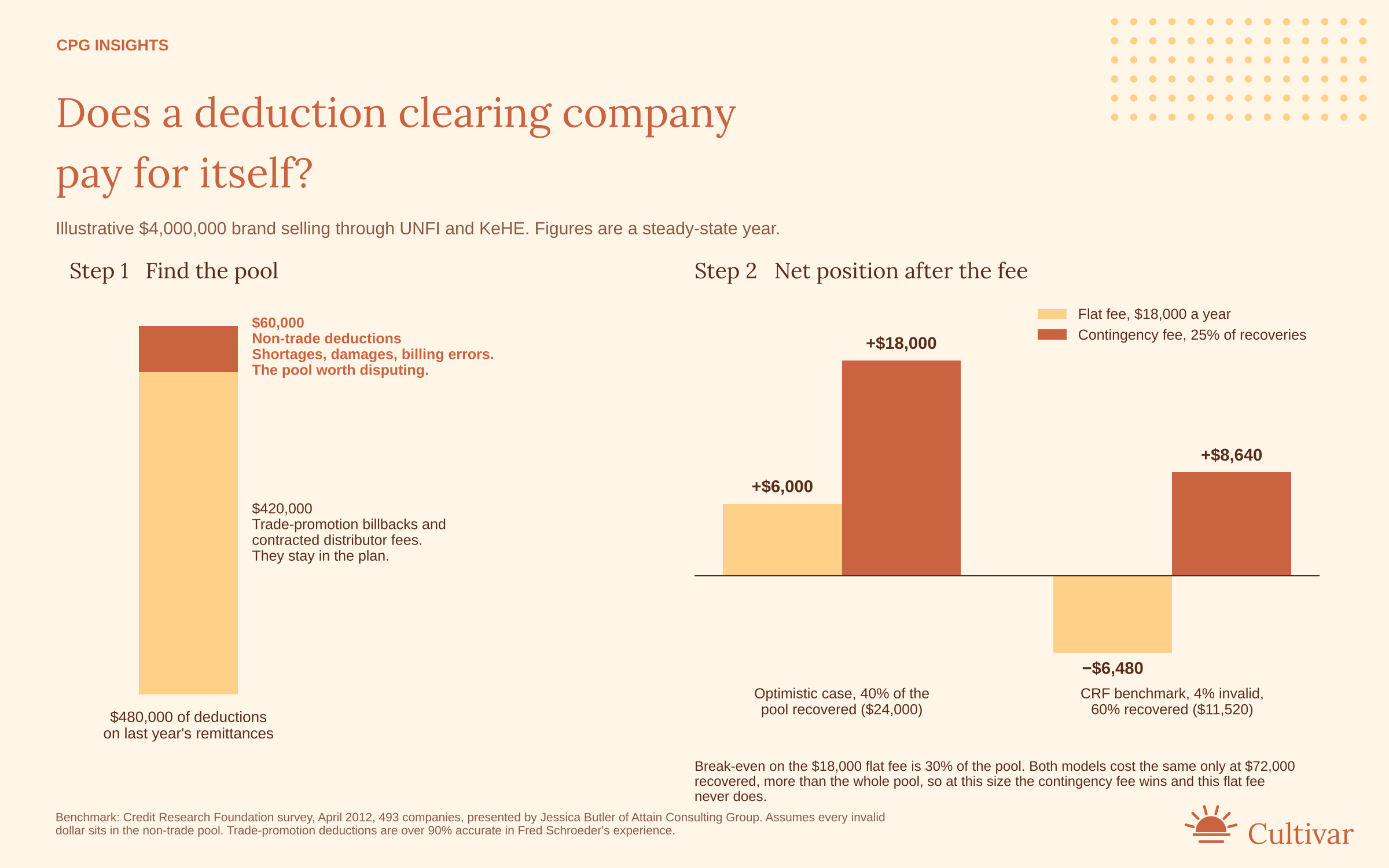
| Total deductions on last year's remittances | $480,000 | 12% of gross revenue |
| Trade-promotion billbacks and contracted distributor fees | $420,000 | Tied to signed contracts, so they stay in the plan |
| Non-trade deductions | $60,000 | The pool |
| Flat subscription quote | $1,500 a month, or $18,000 a year | The annual fee in the formula |
| Break-even recovery rate | 30% | $18,000 ÷ $60,000 |
Take an optimistic case where you recover 40% of the pool, $24,000, in a steady-state year, and the flat fee nets you $6,000.
Check Your Recovery Rate Against the CRF Benchmark
Now check that assumption against a benchmark. An April 2012 Credit Research Foundation survey of 493 companies, presented by Jessica Butler of Attain Consulting Group, found that 3% to 5% of deduction dollars were invalid and that food, beverage, and grocery suppliers recovered a median 60% of those invalid dollars. Assume 4% invalid and 60% recovered on our $480,000, with every invalid dollar sitting in the non-trade pool, and recoveries come to $11,520, which is 19.2% of the $60,000 pool against a 30% break-even, so the $18,000 flat fee finishes $6,480 underwater.
The same survey put median deductions at 2% of sales for suppliers selling mainly to retailers, and 3% for food, beverage, and grocery, so our 12% needs a word. Natural-channel remittances carry distributor fees and promotional billbacks as deductions, and a supplier selling direct to retailers never sees those lines the same way. Vendors cite a far wider spread of invalid rates than the CRF survey found. OverDeduct puts published estimates anywhere from about 5% to 60%, depending on category and retailer, so ask each vendor how it defines invalid.
Flat Fee or Contingency Fee at This Size
Run the same two cases through a contingency model at 25% of recovered dollars.
| Scenario | Recovered | Flat fee of $18,000 a year | Contingency fee of 25% |
|---|---|---|---|
| Optimistic case, 40% of the pool recovered | $24,000 | Nets $6,000 | Costs $6,000 and nets $18,000 |
| CRF benchmark, 4% invalid and 60% recovered | $11,520 | Nets $6,480 below zero | Costs $2,880 and nets $8,640 |
| Point where both models cost the same | $72,000 ($18,000 ÷ 25%) | More than the whole $60,000 pool | More than the whole $60,000 pool |
At $18,000 a year, contingency wins at this size because the fee only exists when a repay does, and the flat subscription never wins for this brand.
The $1,500 quote sits well above the typical range. OverDeduct says most deduction tools charge $299 to $599 a month, and at $599 a month, or $7,188 a year, break-even drops to about 12% and the CRF case nets $4,332. That price also moves the point where both models cost the same down to $28,752 recovered, or 48% of the pool, so a brand confident of recovering more than that would keep more on the cheaper flat fee.
Why Payback Takes a Year or Two
Fred's experience with the brands he advises is more upbeat than our CRF case. On the May webinar he said "most of them will get you back more in repays than you pay them in subscription fees," and on timing his words were these.
"After a year, a year and a half, or two years, you'll be at a cash positive by working with those companies because they do have a way to get the dollars back and they work with the distributors pretty closely to do that."
The lag I see on our side is simpler, in that disputes take months to clear while the fee starts on day one. Our post on accurate cash application covers tying each deduction to the right invoice so false receivables and inflated accruals never build up around them.
Where Deduction Clearing Companies Stop Short
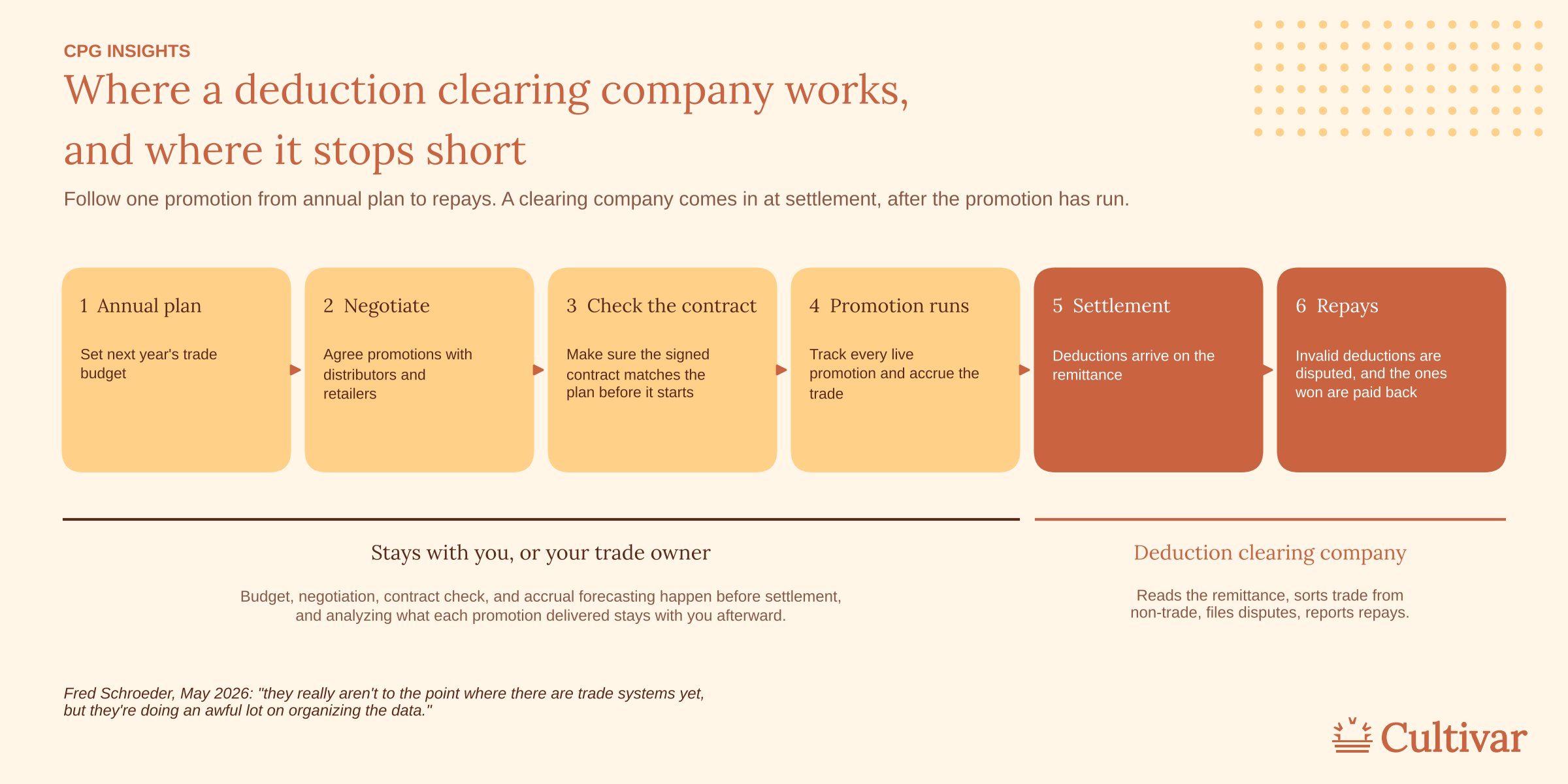
Fred said on the May webinar that "they really aren't to the point where there are trade systems yet, but they're doing an awful lot on organizing the data." Clearing companies work at settlement, near the end of a promotion's life, so four jobs stay with you.
Setting next year's trade budget belongs to your own annual planning.
Negotiating distributor and retailer promotions takes a person who knows your plan and margin.
Checking that the signed contract matches the plan happens before the promotion starts.
Forecasting trade accruals across the full cycle takes someone tracking every live promotion.
On the May webinar Fred said, "I'm typically not someone that's the most bullish on software right out of the gate, but this is an area where that can help." On the August webinar he went further. "I am very pro having something to deal with the deduction piece of this."
What to Check Before You Sign With a Deduction Clearing Company
Match a CPG deduction management provider's pricing and eligibility terms to your own numbers before booking a demo. Fred described deduction clearing companies on the May webinar as "a relatively new, say two to three years, category" with "six or seven" providers by his count.
Two Providers With Different Entry Points
Here are two providers, with details from each company's own site.
| Provider | What it is | Pricing or entry point | Retailers and distributors it reads |
|---|---|---|---|
| Glimpse | AI-powered revenue recovery platform | Pricing comes through a demo, and its recovery guarantee covers brands with at least $100 million in retail revenue across Walmart, KeHE, or UNFI and at least $1 million in shortage deductions | Walmart, Kroger, Amazon, and other retailers, plus KeHE and UNFI |
| OverDeduct | Deduction management software for emerging and mid-market brands | Free deduction analyzer, self-serve plans at $49 or $99 a month, done-for-you recovery at 25% of recovered dollars, and a managed tier priced as a retainer plus a reduced share | KeHE, UNFI, and retailer remittances |
Those details were checked in October 2026, so confirm current terms before you sign.
Four Questions for the Demo Call
Four more questions belong on the demo call.
Ask which distributors and retailers the provider reads today, and check that against where your volume sits.
Ask who files each dispute in KeHE K-Solve or UNFI's supplier portal, you or them.
Ask how the report labels trade and non-trade lines, so each one posts to the right account.
Ask how repays are reported and dated, so your cash forecast sees them land.
Review Your Numbers Before You Sign
Cash flow is what we work on all day, every day at Cultivar. Bring a recent UNFI or KeHE remittance to a working session and we'll sort its trade lines from its non-trade lines together, so you walk into any demo with your own break-even number. Book a working session with Cultivar to review your deduction and trade spend numbers before you sign with a deduction clearing company.
Frequently Asked Questions
Are Deduction Clearing Companies Worth It for Small CPG Brands?
They’re worth it once expected recovery on your non-trade deductions beats the fee. In our $4 million example, a contingency plan or self-serve software clears that bar in both cases, and an $18,000 full-service flat subscription clears it in the optimistic case alone.
How Much Do Deduction Management Services Cost?
Pricing starts under $100 a month for self-serve software and rises to full-service flat subscriptions or contingency fees of about 25% of recovered dollars, so confirm current terms with each provider.
What Is the Difference Between Trade and Non-Trade Deductions?
Trade deductions settle promotions written into a signed contract and are over 90% accurate in Fred's experience, while non-trade deductions are charges tied to operations, like shortages, damages, pricing discrepancies, and billing mistakes.
How Do I Dispute UNFI or KeHE Deductions Without a Service?
Match each non-trade deduction to your invoice, purchase order, proof of delivery, and contract, then file the dispute through K-Solve for KeHE or UNFI's supplier portal with those documents attached.
Related Resources
Cultivar's trade spend management service logs, categorizes, and verifies every chargeback.
How to extend your cash runway gives active deduction management its place on the list of levers that buy a brand time.
Schweiger Vineyards case study follows a two-generation winery that costed all of its SKUs, the same line-level discipline a remittance rewards.