Key Takeaways
Business applicants above $1 million in gross revenue can ask a lender for its specific reasons in writing within 60 days of the decision, and the article includes a two-sentence request you can send this week.
The Federal Reserve’s 2026 small business credit report found that 58% of applicants received less than the full amount, so a partial or full no is the common outcome.
Collecting $45,000 of overdue distributor invoices lifts the example canned wine brand’s runway to 7.2 months with no new debt, which clears the six-month line lenders watch and beats the 5.4 months it began with.
Resizing the $600,000 request to $250,000 for one $240,000 order lifts the example’s debt service coverage ratio to 1.71 against 1.19 on the full ask.
Small banks fully approved 57% of applicants in that same report, the highest rate of any lender type, and the article names the other routes to try after a no.
Hearing no on a five-minute call is a rough way to end a week, especially with a new distributor order on your desk and a co-packer deposit due in a few weeks. Take a breath, because a business loan denied by your bank is a fixable moment. I’ve watched plenty of Founders turn one into a better loan than the one they first asked for. I’m Pedro Noyola, CEO of Cultivar and a CPA (inactive). I mentor Founders in the SKU accelerator, advise emerging food and beverage brands through TIG Collective, and invest in CPG brands with The Angel Group. That mix means I see loan files on the way in and on the way out.
Walk through it with me alongside an illustrative canned wine brand in its fourth year. Last fiscal year it booked $2,400,000 in gross sales, $336,000 in trade spend and deductions, and $2,064,000 in net revenue. Net operating income, the profit left before interest and taxes, came to $150,000. It pays $60,000 a year on an equipment loan, holds $135,000 in cash, averages $25,000 a month in net cash outflow, and is owed $45,000 by distributors past agreed terms. Its bank just declined a $600,000 line of credit for an order that costs $240,000 to produce.
Five steps, taken in order, turn that no into a stronger request to the right lender:
Get the lender’s specific reasons in writing.
Match each reason to a number in your own file.
Check the five things every lender reviews before a line of credit.
Resize the request to one documented need.
Approach the lenders built for brands like yours.
Working Capital Loan Denied? What Should You Do First?
The first step after a working capital loan is denied is a written request for the lender’s specific reasons, which Regulation B entitles business applicants to receive. Regulation B is the rule that puts the Equal Credit Opportunity Act into practice, and the lender’s notice of a decline is what it calls an adverse action notice. Under the Regulation B notice rules, business applicants split at $1 million in gross revenues for the preceding fiscal year, a figure the lender can take on your word.
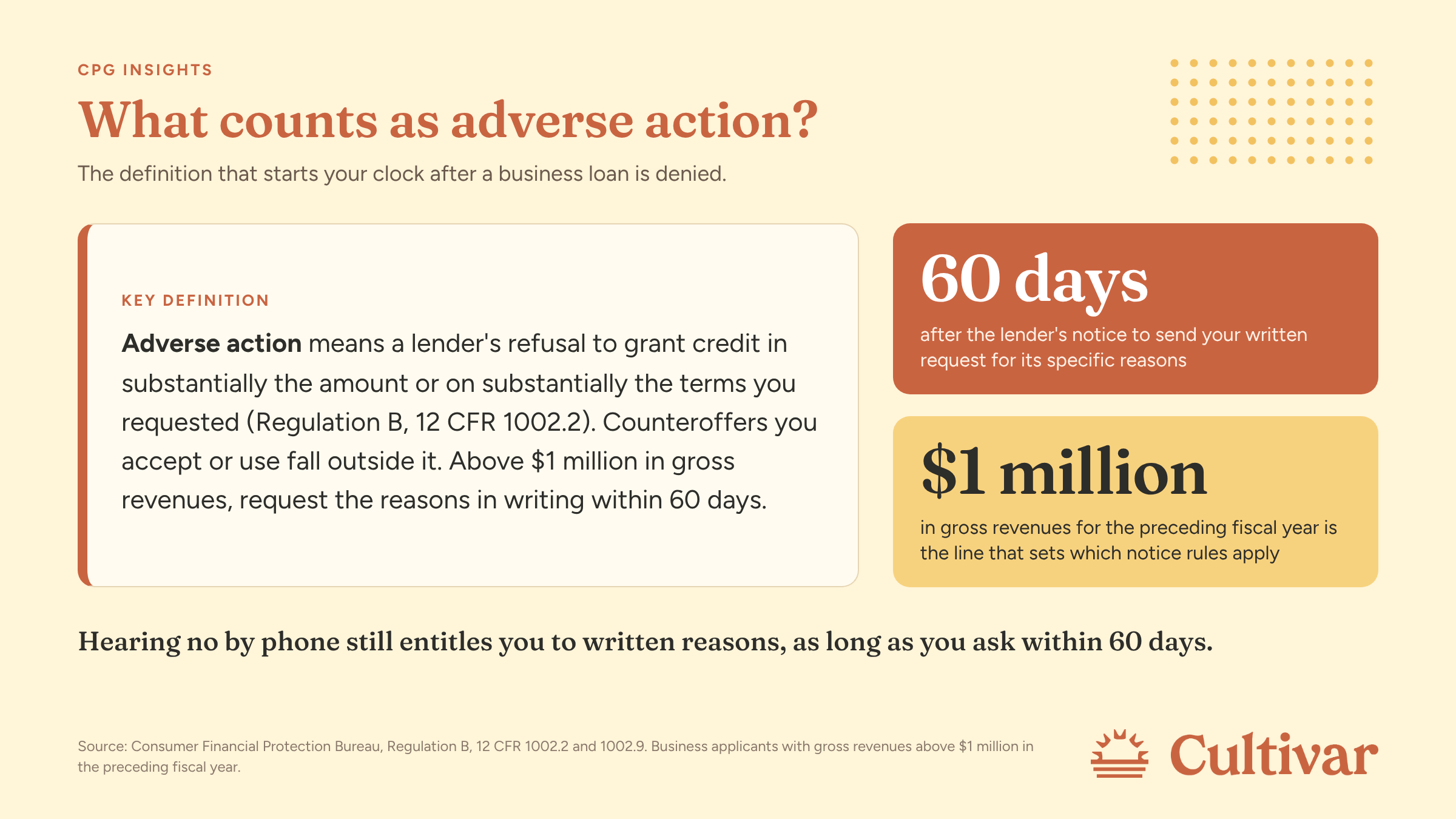
Save this before you call your banker back about the decision.
Above $1 million, the lender can give you its decision orally or in writing within a reasonable time. It owes you a written statement of reasons once you make a written request within 60 days of that notice, so the phone call started your clock. Our canned wine brand clears $1 million on gross sales and on net revenue, so the 60-day route is the one it takes. Net revenue means gross sales minus trade spend (promotions, discounts, allowances, and fees paid to retail and distributor partners) and deductions (amounts a partner takes off a payment).
Reasons have to be specific, so “internal standards or policies” or a failed score on the lender’s own system falls short of the rule. Any counteroffer you accept sits outside adverse action entirely. Your request can be two sentences. “Thank you for reviewing our application for a $600,000 line of credit, which you declined by phone on October 14. Under Regulation B, please send a written statement of the specific principal reasons for that decision.” Save a dated copy of what you send. Take any question specific to your lender or your state to an attorney, because I’m a CPA (inactive) and a mentor, and I know where my lane ends. Y’all, send that request this week.
Why Was My Business Loan Denied?
The Federal Reserve’s Small Business Credit Survey tracks the six most-cited reasons firms give for being denied financing. Four of them point to figures a CPG Founder can check in their own file. Its 2026 Report on Employer Firms, published in March, found that 42% of applicants received the full amount they sought, 36% got some or most of it, and 22% got none. So a partial or full no was the experience of 58% of the small employer firms that applied.
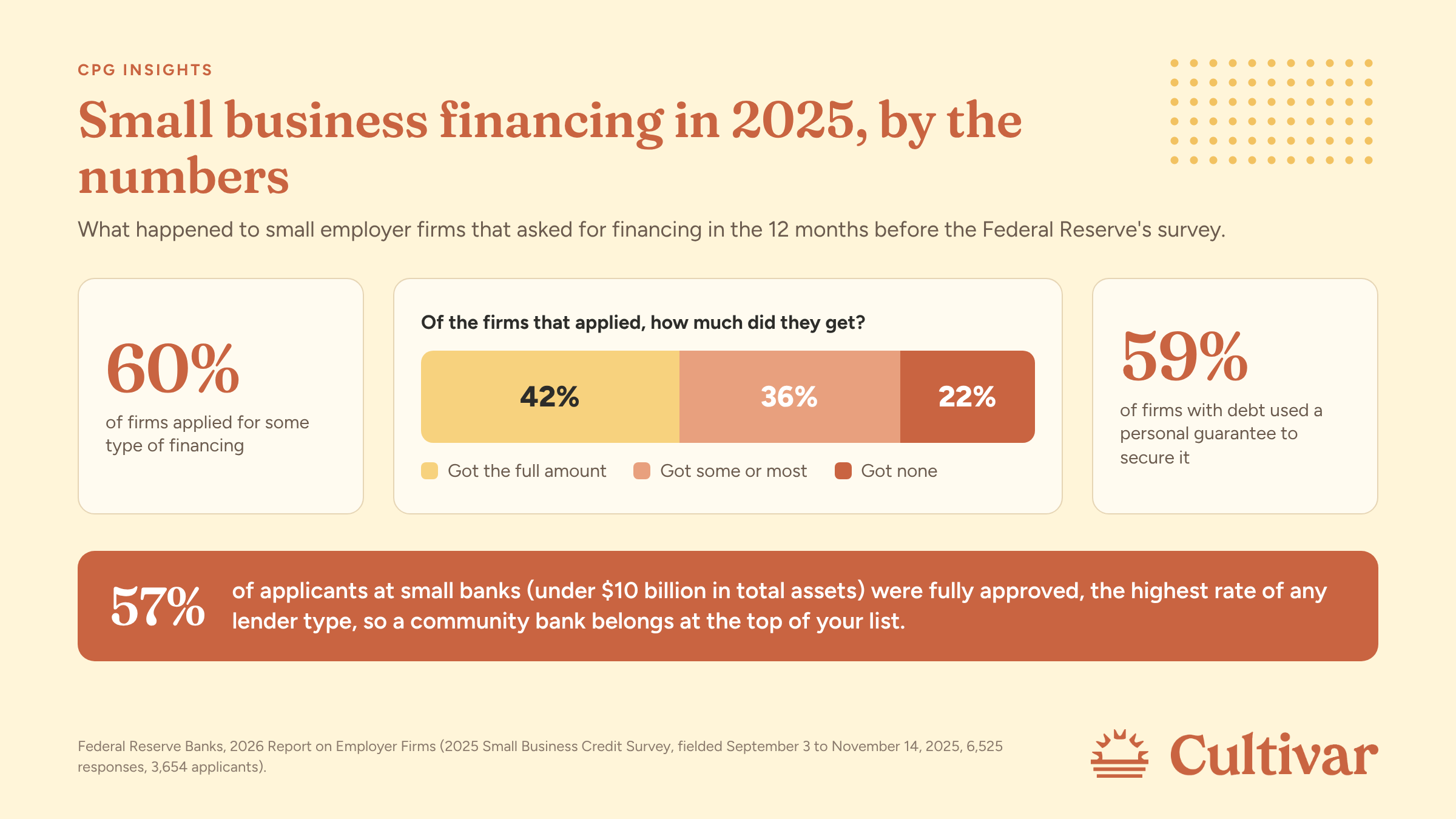
Share this with your business partner, because 58% of applicants got less than the full amount.
Each reason points somewhere specific in your file, and a business loan denied for one of them is a number you can move before the next lender reads it.
| Reason firms report | Where it points in your file | Your move this month |
|---|---|---|
| Too much debt already | Annual debt service across your loan schedules | Resize the request so new payments fit your coverage ratio (step four) |
| Low credit score | Your business credit file, plus your personal file if you signed a guarantee | Ask if the lender reviewed a guarantor’s personal credit, and pull your own reports |
| Insufficient collateral | Receivables and inventory on the balance sheet | Report both accurately so they can stand as collateral |
| Weak sales | Net revenue after trade spend and deductions | Reconcile net revenue to your remittances before the next application |
| Lender requirements too strict | Lender policy | Change lenders (step five) |
| Lenders do not approve financing for businesses like mine | Lender policy | Approach lenders built for small employer firms and CPG (step five) |
Know your net revenue after trade spend and deductions before the next lender asks. When I look at a brand’s numbers as an angel investor, that’s the first line I check, and lenders read it the same way. That same report found that 59% of firms with debt used a personal guarantee, the owner’s promise to repay if the business can’t. If you signed one, ask the lender if it reviewed your personal credit. Check your free weekly credit reports at AnnualCreditReport.com, where each of the three bureaus lets you look once a week and dispute mistakes. Receivables, the invoices your customers haven’t paid yet, and inventory can back a working capital line or CPG inventory financing only when the books report them accurately. Closed books sit on the checklist in step three for exactly that reason.
What Do Lenders Check Before Approving a CPG Line of Credit?
My lender pre-assessment checklist names five things a lender reviews before approving a CPG line of credit. They are cash runway, the cash conversion cycle, a forecast of signed deals, three-statement financials, and closed books with recent tax returns. I shared it in a LinkedIn post that opens “Landed a game-changing deal at Expo West?” The line I’d underline today is that less than 6 months of runway is “a major red flag and often a deal breaker.”
Runway is the number of months of cash you have left at your current pace.
| Runway in months |
|---|
= Cash on hand ÷ Average monthly net cash outflow |
Our canned wine brand holds $135,000 against $25,000 a month in net outflow, so its runway is 5.4 months and sits inside my red flag zone. Collecting the $45,000 in distributor invoices past their agreed terms lifts cash to $180,000 and runway to 7.2 months, with no new debt and no new sales. Collections are the fastest lever that moves runway across that line, and all it takes is a little ganas, the Spanish word for drive, on the phone.
| Line | Before collecting | After collecting |
|---|---|---|
| Cash on hand | $135,000 | $180,000 |
| Average monthly net cash outflow | $25,000 | $25,000 |
| Runway | 5.4 months | 7.2 months |
Your cash conversion cycle (CCC) counts the days your cash stays tied up between paying for inventory and collecting the customer’s payment. Shorten that cycle and a smaller line covers the same order. Three-statement financials mean the statement of cash flows, the profit and loss statement (P&L), and the balance sheet for at least 12 months, ideally 18 to 24. Tax returns for the last year or two sit beside them. Closed books mean every one of those months is matched to your bank statements and final. Cultivar built Spirit Tea’s cash flow forecast so Jordan Scherer could see runway and plan working capital, alongside loan packaging for a line of credit that’s still in progress. Lenders want that same model with your signed deals added at the top.
How Much Should I Ask For After a Loan Denial?
After a loan denial, size the next request to one documented need, such as a signed order’s production cost. Asking for less lowers your new debt service and raises your debt service coverage ratio. DSCR compares the cash you have available for debt payments with the principal and interest you owe in a year. At 1.0 the cash covers the payments with nothing to spare, and each lender sets its own minimum.
| Debt service coverage ratio |
|---|
= Net operating income ÷ Total annual debt service |
With $150,000 in net operating income and $60,000 in equipment loan payments, our brand sits at a DSCR of 2.50 today. Borrowing all $600,000 at an illustrative 11% interest-only rate adds $66,000 a year, and the ratio falls to 1.19. Interest-only means you pay the interest each year and the principal later. Resizing to $250,000 for the $240,000 order adds $27,500 and lands the ratio at 1.71, up 0.52 on the original ask. At 1.71 your coverage finally has room to breathe, which is more than a canned wine ever needs to do.
| Request | New annual payments at an illustrative 11% interest-only | Total annual debt service | DSCR |
|---|---|---|---|
| No new debt | $0 | $60,000 | 2.50 |
| $600,000 line, fully drawn | $66,000 | $126,000 | 1.19 |
| $250,000 line for the $240,000 order | $27,500 | $87,500 | 1.71 |
Tying the request to one signed order shows the lender exactly where each dollar goes and when it comes back. I get stoked when a Founder walks in with the purchase order clipped to the front of the application. Our CPG loan support service sizes a request off a cash conversion cycle analysis and assembles the 24-plus documents, models, and reports a lender-grade package needs. The number you ask for and the file behind it then agree.
Where Can I Get a Food and Beverage Business Loan After a Bank Says No?
After a bank says no, a food and beverage business loan can still come through a small bank, SBA Lender Match, a nonprofit community lender such as Accion Opportunity Fund, or your original banker with a smaller ask. In the Federal Reserve’s 2026 report, 57% of applicants at small banks, those under $10 billion in total assets, were fully approved, the highest rate of any lender type. Put the community bank down the road at the top of your list. SBA Lender Match prepares a summary of the interested lenders two business days after you submit a request, and the SBA says plainly that it doesn’t guarantee a match or an offer.
Accion Opportunity Fund calls itself a nonprofit Community Development Financial Institution (CDFI), meaning a lender whose primary mission is community development. Its term loans reach $250,000 over up to 36 months. On the Accion Opportunity Fund term loans page, the criteria are 2 years in business, $300,000 or more in annual sales, 20% ownership for the applicant, and all shareholders as US citizens or permanent residents. It doesn’t lend to businesses in DC, Montana, North Dakota, South Dakota, Tennessee, or Vermont. Accion also says its loan amounts typically don’t surpass 20% of a business’s annual revenue, and $250,000 sits inside that line on $2,400,000 of gross sales. I checked those criteria in October 2026, and they change, so read each lender’s page the week you apply.
Repaying $250,000 over 36 months at the same illustrative 11% costs about $98,200 a year. On that structure our brand’s DSCR would be 0.95, meaning the year’s payments would exceed the profit available to cover them. Rework the ratio with each lender’s real payment schedule before you apply. My post on the CPG loan process shows how one rejection turns into several lenders competing for the same file, and you gotta let them compete.
When Is My CPG Brand Ready to Reapply for a Loan?
Your CPG brand is ready to reapply when every written reason on the lender’s statement has a matching fix you can show in documents. Go back to your original banker with one newly closed month of accrual financials, meaning books that record revenue when it’s earned and expenses when they’re incurred. Ask “What would need to change for you to approve this?” That question works even while you talk to other lenders, and one closed month shows the fixes are already working.
My bluntest advice to every Founder I mentor is that lender prep, cash flow, trade spend, and margin share one set of books. One cleanup serves all four at the same time. Store the written request, the lender’s reasons, each dated fix, and the newly closed month in one folder, because the next lender will ask for the story in that order. Your business loan denied in October can become a file you bring back stronger in the new year.
The no you heard this week is one data point, and the file you build over the next month is the rest of the story. Every number in this article came out of books a Founder can clean up, and so will yours.
I’d love to help you turn this no into a stronger application. Book a call with Cultivar, and we’ll clean up your books and build a lender-grade loan package together before you reapply.
Frequently Asked Questions
Does a Denied Business Loan Show Up on My Credit Report?
No, because credit reports list inquiries and not decisions, so the denial itself never appears. One hard inquiry, the record left when a lender pulls your full personal report, can stay on it for two years, and business credit bureaus can show the inquiry too.
Will Applying With Several Lenders Hurt My Personal Credit Score?
Each hard inquiry can trim a few points for a short time, and many lenders prequalify with a soft pull that leaves no mark on your score. Ask each one which type it uses before you authorize anything.
Can I Use a Distributor Purchase Order to Get Financing for My CPG Brand?
Yes, purchase order financing pays your co-packer against a signed order and collects when the distributor pays. Invoice financing advances cash against invoices you’ve already sent, and both cost more than a bank line. Funders read your books the way a bank does, so the order, the invoice, the receivable, and your deduction history have to be clean.
Can a CPG Brand Get a Working Capital Loan With Less Than Two Years of Sales?
Banks and lenders such as Accion Opportunity Fund usually set a two-year floor. Younger brands look to SBA microloans, which reach $50,000 through nonprofit intermediary lenders, and to CDFIs with startup programs. Invoice or purchase order financing judges your customer’s credit along with yours, and longer payment terms negotiated with your co-packer can cover part of an order with no loan at all.
Related Resources
Cultivar’s CPG accounting services close the books monthly and deliver the P&L, balance sheet, and cash flow report a lender reviews.
My post on how to know if your CPG brand is ready for working capital financing checks if you need more cash, tighter discipline, or both, across four readiness checks.
Cultivar’s Schweiger Vineyards SKU costing model shows the cost of each bottle, vineyard to glass, so Andy Schweiger can price with confidence and spot the most profitable channels.