If You Only Have One Hour a Week for Trade Spend, Do This
Near the end of our May webinar, I said out loud what we all knew, that y'all are "all wearing 10 hats." Knowing what to prioritize is one of every CPG brand Founders’ biggest challenges, and trade spend is a minefield. I asked Fred Schroeder what to do if you only get one hour per week on trade spend tracking, because it’s one of the jobs I watch brilliant brand builders flounder over time and time again. Take it from me, you won’t find time to think about it when things calm down. Things never calm down, and I say that with love, because I'm right there with you.
My advice today comes from our trade spend webinars with Fred Schroeder (May 6 and August 19, 2026). Fred worked at Procter & Gamble and Coca-Cola's Minute Maid division, then led two trade promotion software companies. Today he advises small brands about trade spend as a fractional expert. He lights up over a deduction code the way most people light up over dessert, which is exactly why we get along.
Keep reading to see how we’ve turned Fred’s guidance to optimize trade spend tracking into the four hours in month one that set your target, the four-week loop that follows every month after, the owner that hour needs, and the order to roll it out across distributors and retailers. You gotta start somewhere, and one hour is plenty to get rolling.
Start With the Gross-to-Net P&L You Actually Want
Your first four hours build the target. Your gross-to-net P&L walks full invoiced revenue down to what's left after every allowance and deduction, with P&L short for profit and loss statement. On the May webinar Fred said to "start with a pro forma of where you think this P&L is, whether it's off the top of your head or using the numbers you have today," and that rough first version is your pro forma P&L, your baseline, which hour two turns into a target.
Hour one goes to pulling the last 12 months of gross invoiced revenue and every trade-related account from your books, including retailer ad fees booked under marketing, which gives you the pro forma. If the books aren't clean, hour one is the last three months of UNFI and KeHE remittances with the deduction lines totaled by code.
Hour two sets your target trade rate, meaning trade spend as a percentage of gross revenue, and writes the target gross-to-net P&L, from gross revenue through terms, unsalables, broker commissions, and trade down to net revenue.
Hour three splits the target trade line into MCBs, off-invoice allowances, and lump sums, with the cases you expect to promote beside each.
Hour four writes the same page for each distributor, because UNFI and KeHE are where tracking starts.
Say you project $2,400,000 in gross revenue and your margin plan needs trade held at 18%. Your trade budget is $432,000 a year, or $36,000 a month, split in the target as $12,000 a month in MCBs, $14,000 in off-invoice, and $10,000 in lump sums. Nielsen data cited by McKinsey showed 72% of US trade promotions lost money, so set the target before a dollar goes out. Our guide to building a roadmap to profitability shows where that line sits in the full model.
Trade Spend Tracking Takes About an Hour a Week Once It's a Standing Habit
Fred offered monthly or quarterly checks "whether you have time to do it," and four hours a month buys you the monthly version. His instruction for each check was to "know where it is and where it's trending and know what areas you need to address," so months two onward follow one four-week loop.
In week one, pull last month's gross revenue and the trade your bookkeeper accrued for last month's promotions, trued up for any deductions that cleared, work out the trade rate, and set it beside your target.
In week two, split actual trade into MCBs, off-invoice, and lump sums, put last month's case counts beside each, and flag any line more than 10% over or under its plan.
In week three, trace each flagged line back to one retailer, one distributor, and one promotion, because a bucket only tells you money moved, and the promotion behind it tells you whether to change the plan or question the deduction. Find the promotion's deduction code on the remittance, lay it beside the signed contract, then lay the contract beside your plan, where Fred finds most of the gaps.
In week four, write down what changes next cycle and make the one call that fixes the biggest line.
Here's month two at our $2,400,000 brand, once its MCB deductions have cleared. Week one shows $200,000 of gross revenue on 5,000 cases and $42,000 of trade spend, a 21% trade rate against the 18% target. Across a year that gap is $72,000. Week two shows the plan at $12,000, $14,000, and $10,000 against actuals of $16,800, $14,000, and $11,200, so two lines moved and your hour now has a $6,000 target with a name on it. The MCB line came back at $5.60 a case on 3,000 promoted cases, billed on the distributor's wholesale price, against the $4.00 a case in the plan, and the lump-sum line carried an ad fee nobody planned.
Pistakio Co-Founder Nicola Buffo got clearer margin and cash flow visibility once Cultivar rebuilt Pistakio's chart of accounts.
Split the Trade Line Into MCBs, Off-Invoice, and Lump Sums Before You Can Fix It
Week three is where the numbers enthusiast in me comes alive, because each bucket moves for its own reason. MCB stands for manufacturer chargeback, the amount a distributor bills you back for a promotion it passed through to a retailer.
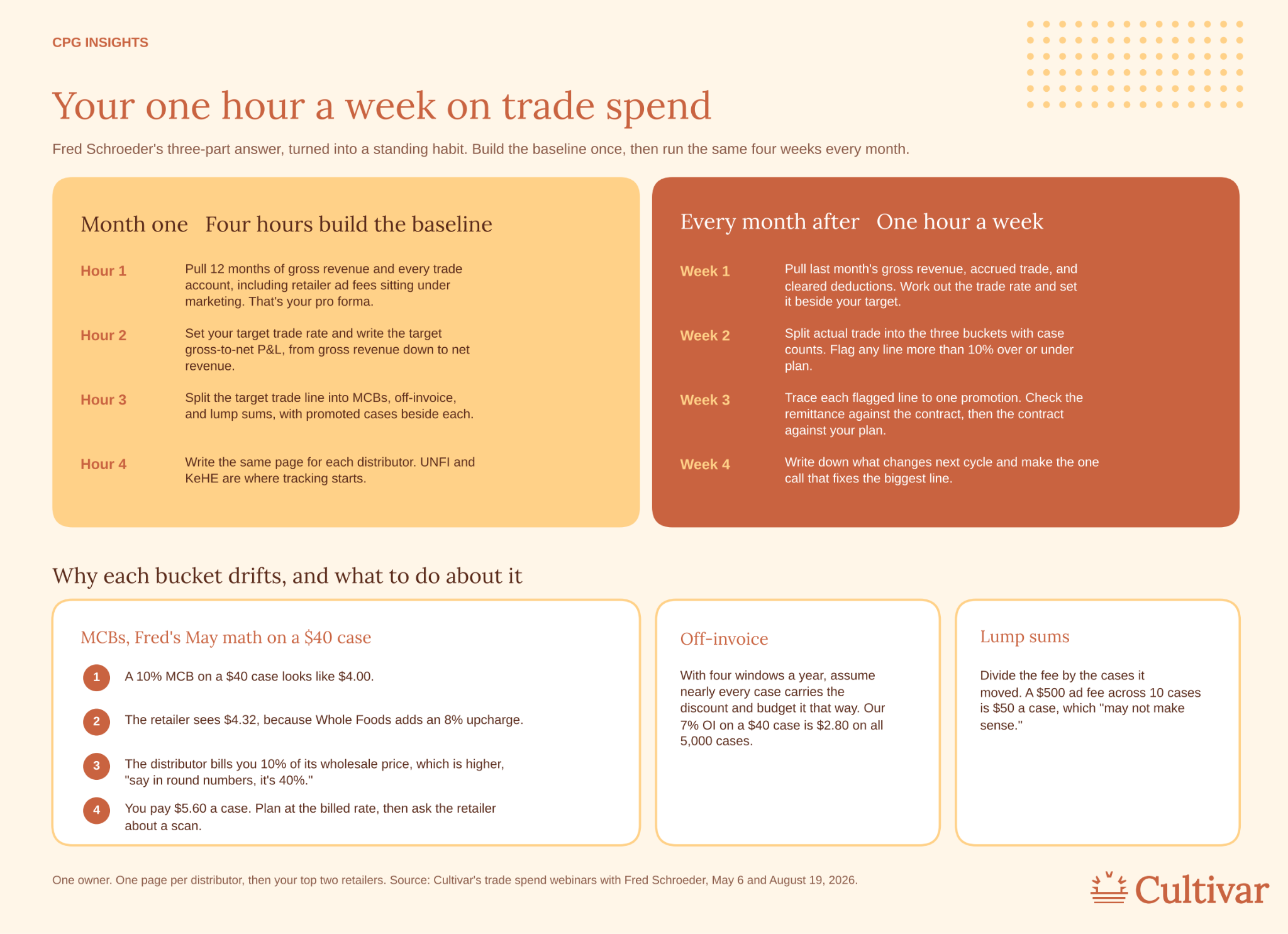
Off-invoice, or OI, is a temporary discount off your invoice price to the distributor during a set window. Our brand gives a 7% OI on a $40 case, so the plan assumed $2.80 on all 5,000 cases, or $14,000, following Fred's advice that a grocery brand running four OIs a year should assume "100% of your volume" carries the discount, and that's the line that matched.
Lump sums are flat fees for a specific slot, like an ad fee or a TPR fee, with TPR meaning temporary price reduction. Fred's May example was a $500 fee at a five-store chain where each store sold two cases, so "that's $50 a case," and "it may not make sense to do ads that require a $500 fee." Our extra $1,200 was an unplanned ad fee that moved 24 cases, the same $50 of trade spend per case, more than the $40 the case sells for. Our trade spend management service logs, categorizes, and verifies every chargeback and deduction so the per-case math is ready.
Week four's call goes to the retailer behind the MCB line, asking to move that promotion to a scan, which pays only on units the shopper buys, and the change written down for next cycle is a per-case ceiling on ad fees.
Give Trade an Owner, Even If It's One Hour a Week
Fred said on the August webinar that "trade promotion needs an owner plain and simple." He puts trade marketing in the middle of leadership, finance, sales, and brokers. Finance tracks the dollars, and sales "is really accountable for getting results." He said the role "could be a couple of hours a quarter. It could be a couple of hours a day. It could be a full-time person," so your hour a week sits inside that range, and the owner is the one person who sets trade objectives and pulls sales and finance together.
Across the brands we work with, from zero to $30 million in revenue, the Founder or head of sales usually holds trade by default. You get to bring one hour and real ganas, the Spanish word for drive.
The owner's first job is Fred's opening question to every brand he's considering working with, "what are your measurements?" and "what have been your results over the last 6, 12, 24 months." Most people, he said, "haven't gone far enough to know." He compared it to a 401k. "Don't just let it sit there. You got to be involved in it. You got to look at it. You got to make sure it's achieving your objectives." Hours one and two of month one answer it in writing.
Roll It Out in Order: Distributors First, Then Your Top Two Retailers
Fred's May timeline sets the hour's scope. "I'm going to have it done at the distributors in a month or two months. I'm going to have it done at my top two retailers another month after that."
Months one and two keep the hour on the UNFI and KeHE pages you built in hour four.
Month three adds your top two retailers by volume as their own pages, with every other retailer in one combined line until those pages are steady.
Each page carries the same lines you wrote in hour two, so adding a retailer costs minutes.
One Hour a Week, One Owner, One Page
Four hours build the target, then one hour a week pulls actuals, splits the trade line, and makes one call. That's Fred's three-part answer built into a weekly trade spend tracking habit.
On the May webinar I said "you get what you get and you can't get upset when you're just getting started, but you need to know what you're signing up for." Y'all, one hour a week is how you know, and I'm stoked every time a Founder blocks that hour in the calendar.
Schedule a call with Cultivar to build your target gross-to-net P&L and the trade spend tracking system around it.
Frequently Asked Questions
How Much Time Does Trade Spend Tracking Take for a Small CPG Brand Each Week?
About four hours builds the target gross-to-net P&L, and one hour a week after that covers a monthly review, with most of it spent on the lines that moved.
What Is a Pro Forma P&L in Trade Spend Tracking?
It's your best estimate of where your gross-to-net P&L stands today, built from current numbers or even off the top of your head, and it's the baseline your target and monthly actuals get measured against.
Should I Review Trade Spend Monthly or Quarterly?
Fred said either works, depending on "whether you have time to do it," and an hour a week is enough for the monthly version, which flags a drifting line within a month.
Who Should Own Trade Spend at a Small Food and Beverage Brand?
One named person should own it, usually the Founder or the Founder working alongside whoever leads sales, even if the job takes an hour a week.
Related Resources
Financial planning and forecasting covers the budget-to-actual tracking that a gross-to-net target feeds.
Why your accountant needs to be a CPG expert explains why COGS, inventory, cash flow, and compliance need an accountant who knows CPG.
Hudson Vineyards case study shows how Cultivar brought back a winery's annual budget after years without one, across its winery, vineyard, and custom crush lines.